Pump.fun Bonding Curve Mechanics: How Price Moves
Pump.fun bonding curve mechanics: formula, five phases, 85 SOL graduation threshold, trader strategy on entry vs exit. Full walkthrough from scratch.

Pump.fun spawns thousands of new memecoins every day. Roughly 2-3% graduate to PumpSwap; the other 97-98% die inside the bonding curve at near-zero value. Knowing which side a token is on requires understanding how the bonding curve actually works. This guide covers the math, how price moves with supply, the 85 SOL graduation threshold, and what to watch for as a trader.
What a bonding curve is
A bonding curve is an automated pricing mechanism where the token price is set by a math formula based on circulating supply. There is no order book. You buy, supply rises, the next buy costs more. You sell, supply falls, the next sell costs less. The curve gets steeper the more trades happen.
Pump.fun specifically uses a quadratic bonding curve: price is the derivative of supply squared. Practically: the first 50% of the supply is "cheap"; the last 50% gets dramatically expensive. Early in the curve, 1 SOL buys a large chunk of tokens; late in the curve, the same 1 SOL buys far fewer.
Pump.fun bonding curve mechanics
Pump.fun uses fixed parameters for every token:
- Total supply: 1,000,000,000 tokens
- Initial virtual SOL in the pool: 30 SOL (curve starting reserve)
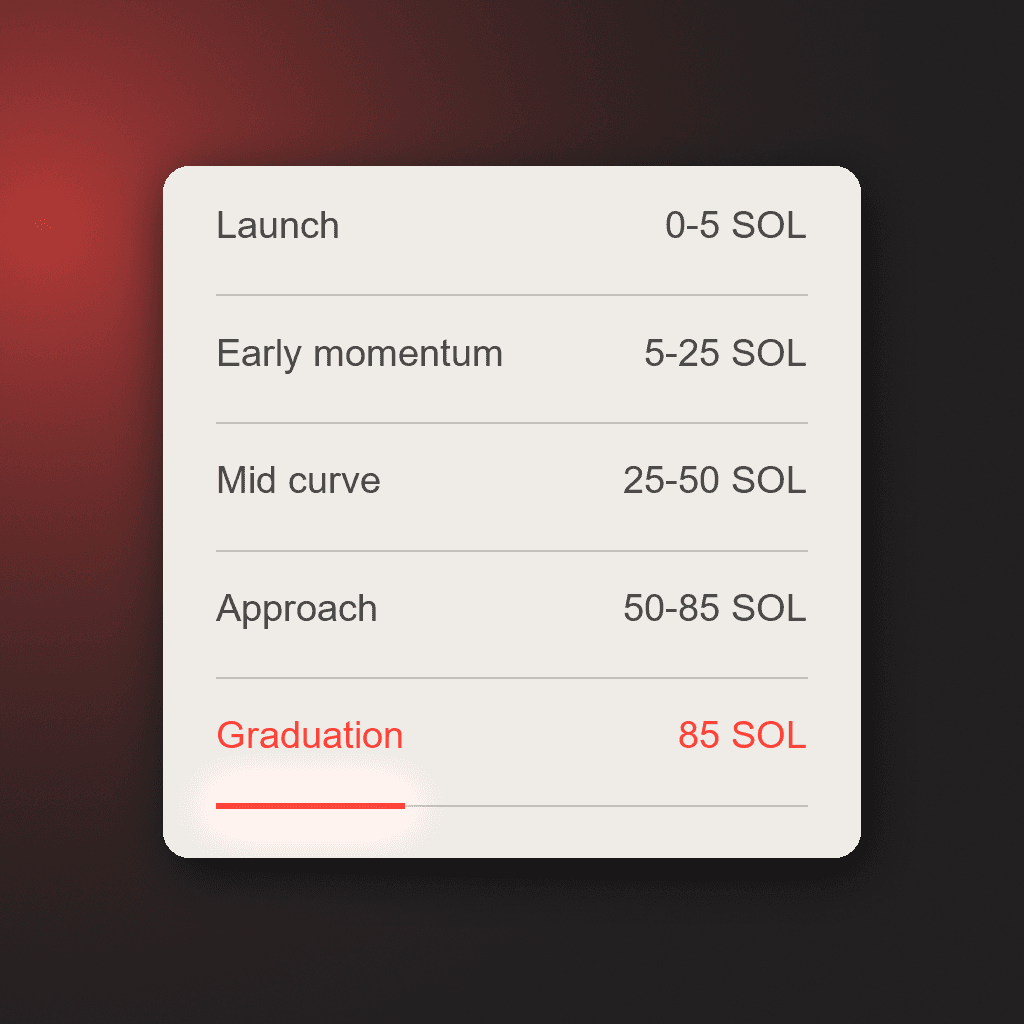
- Graduation threshold: ~85 SOL in the pool triggers graduation
- Dev buyback fee: about 1%
- Trading fee: 1%
Logic: as SOL flows into the pool, token price rises along the curve. When the curve completes (85 SOL in the pool, ~800M tokens distributed to holders), the bonding curve closes and the remaining ~200M tokens plus the collected SOL move automatically into a PumpSwap pool, Pump.fun's own AMM (until March 2025 this step went to Raydium, minus a 6 SOL migration fee). LP tokens are burned; the pool is permanent. The project leaves the bonding curve and trades on PumpSwap going forward.
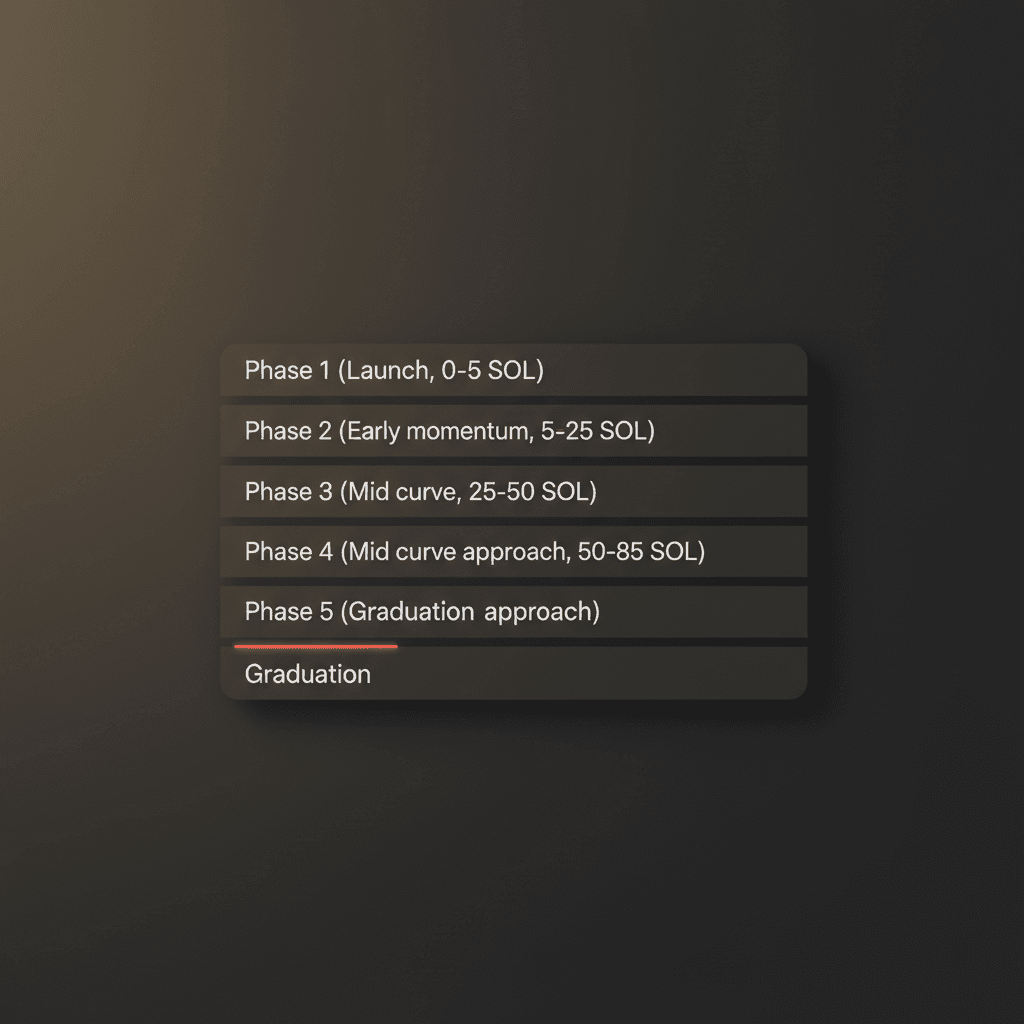
The five phases of the Pump.fun bonding curve
Phase 1: Launch (0-5 SOL)
Token is created, the first 5 SOL of buys lands (usually dev or snipe bots). Price is very low, market cap a few thousand dollars. This is the make-or-break phase: either the token rockets to 10-20 SOL fast, or it hits zero.
Phase 2: Early momentum (5-25 SOL)
Volume grows, holder distribution widens, social momentum starts. Price action in this phase is roughly 10-30x. An early wallet that bought 1 SOL can be at 30 SOL profit. Risk is still high; about 70% of tokens fail to clear this phase.
Phase 3: Mid curve (25-50 SOL)
Token enters trending lists, KOLs notice, FOMO kicks in. The curve is now steeper. New buyers get fewer tokens per SOL; volume is high but profit margins shrink.
Phase 4: Approach to graduation (50-85 SOL)
Token is close to graduation; many traders bet on whether it will graduate. Snipe bots are heavily active in this phase. As the pool nears 85 SOL, price volatility becomes extreme.
Phase 5: Graduation
When the pool fills 85 SOL, Pump.fun automatically migrates the ~200M reserved tokens and the collected SOL into a PumpSwap pool. LP burns. Mint authority is revoked. Trading moves from the bonding curve to a classic AMM, and price action no longer follows the curve.
When to buy and when to sell, from the trader side
Ideal entry: phases 2-3 (5-25 SOL), if social momentum and holder distribution are widening. This window has the highest profit margin on winners, but 70% of tokens fail this phase, so loss risk is steep.
Safer entry: phase 4 (50-70 SOL), if graduation looks near-certain. Profit margin drops (rarely more than 5-10x), but the hit rate is much higher.
Exit: many traders sell at graduation. The first 5 minutes after graduation see dump volatility; price often drops 30-50%. If you intend to hold long-term, the dump pressure clears within 24 hours and the market settles into a natural level.
For fast exits, the Solana multi-swap tool routes through Jupiter for the best rate and sells in one signature. For coordinated multi-wallet exits, the Solana bundled trade tool closes positions across many wallets in a single Jito bundle.
Launching a token on Pump.fun
You can launch directly from the Pump.fun UI or via tooling. The Pump.fun token creation tool ships a bonding-curve launch with no code: name, symbol, image, description, social links. Mint authority, freeze authority, and LP burn are handled automatically at launch. Cost: ~0.02 SOL (dev fee) plus Solana network fees.
Post-launch tooling: the Solana multi-sender tool distributes early-holder rewards via CSV bulk airdrop. The Solana token snapshot tool exports the live holder list from a mint address for tracking distribution.
Common misconceptions
"You can manipulate the bonding curve": Pump.fun's curve is an on-chain Solana program with no manipulation knob. Price moves come from real buys and sells.
"Graduation = guaranteed profit": not at all. The first 24 hours after graduation are highly volatile; 50%+ drawdowns happen. Graduation is the start of a different market, not a finish line.
"Buy early, sell at graduation, profit": 97-98% of Pump.fun tokens never graduate. The average outcome of buying early and holding 30 days is 95%+ loss.
"High volume means safer": bot-generated volume is widespread. Check volume source wallets on DexScreener. If 5-10 wallets dominate, you're looking at fake volume.
Frequently asked questions about the Pump.fun bonding curve
Does the Pump.fun bonding curve ever go down?
The price follows supply in both directions. Buys push it up, sells push it back down along the same curve. What it never does is move on its own: with no trades, the price sits exactly where the last trade left it.
What happens to the SOL collected on the curve?
It stays in the curve account until graduation, then seeds the AMM pool. That is why the creator cannot withdraw it mid-curve, and why a pre-graduation token cannot be rugged the classic way.
Can I sell before graduation?
Yes, at any point. Selling back into the curve is how the price comes down, and there is always a bid because the curve itself is the counterparty. Liquidity is thin at the very bottom, which is where the slippage bites.
Why does the market cap number look higher than the SOL raised?
Because market cap multiplies the current curve price by the full supply, while the SOL raised counts only what has actually been paid in. The two move together and are never the same number.
Is graduation guaranteed if a token gets close?
No. Plenty of tokens stall in the high seventies and drift back down. The last stretch is where the largest early holders decide whether to keep going or take the win, and nothing in the mechanism forces the outcome either way.
Does buying earlier on the curve always mean a better price?
On price alone, yes: earlier is cheaper by construction. On outcome, no, because most tokens never leave the first phase. Being early is a discount on a lottery ticket, not an edge.
What's next
With the bonding curve mechanics in place, you can navigate Pump.fun launches and trades from scratch. For launching, the Pump.fun token creation tool; for post-graduation trading, the multi-swap tool. If you want a classic launch path instead, the Solana token creator tool plus Raydium pool open tool is the alternative. More guides at the Solana token guides category and Solana tag page.
Every number on this page is readable from the chain itself: the curve state is a program account, and the account model that makes that possible is described in the Solana account documentation, with the launchpad side in the official Pump.fun documentation.
The bonding curve formula
The prose above describes how price climbs with supply. Here is the actual rule behind it. Pump.fun's curve is a constant-product market, the same invariant that powers a normal AMM, but run against virtual reserves seeded at launch instead of real deposits.
The invariant is:
x × y = k
where x is the virtual SOL reserve, y is the virtual token reserve, and k is a constant fixed at launch.
Every token starts from the same numbers, which is why two different Pump.fun coins behave identically until real money flows in:
- Token supply on the curve: 1,000,000,000 tokens (about 800M sold through the curve, roughly 200M reserved for the PumpSwap pool at graduation).
- Virtual SOL reserve at launch: a small seed amount. This seed is why the very first buy is not infinitely cheap.
- Graduation threshold: a fixed amount of real SOL collected in the pool before migration.
When you buy with an amount of SOL, that SOL is added to x, and the tokens you receive are whatever keeps k unchanged: y_new = k / x_new, and your tokens are y_old − y_new. Because y shrinks as x grows, each successive SOL removes fewer tokens than the last. That single equation is the entire reason early buys feel cheap and late buys feel expensive. There is no second knob.
Reading bonding curve progress and market cap
The progress bar you see on a Pump.fun token is just how much of the graduation target has landed in the pool. At 0% the pool holds almost nothing beyond the virtual seed; at 100% it has collected the full graduation amount and migrates. So a token at 50% progress has roughly half the target in real buys behind it, not the full market cap.
The displayed market cap is the current curve price multiplied by the full 1B supply. Because price rises along the curve, market cap and progress move together but are not the same number: a coin can show a market cap far above the SOL actually raised, since the late, expensive part of the curve has not been bought yet.
When you are sizing a position, read the SOL in the pool first and treat the headline market cap as a derived figure. To see who actually holds the supply behind that number, the Solana holder snapshot and analytics tool exports the live holder list from any mint so you can spot whether a handful of wallets own the float.
What happens after the bonding curve completes?
Graduation is a single on-chain event, not a gradual process. The moment the pool fills its graduation target, the bonding curve program closes and the reserved tokens plus the collected SOL are deposited into a PumpSwap AMM pool, Pump.fun's own exchange. The LP tokens from that deposit are burned, which is why the liquidity is permanent and cannot be pulled. From that block onward the token no longer prices off the curve at all; it trades like any other AMM pair, on classic x × y = k against real liquidity.
Two practical things change for a holder. First, slippage behaves differently: a thin freshly graduated pool can move hard on a single large sell, which is exactly why the first minutes after migration are so violent. Second, the token is now an ordinary SPL pair, so the full set of liquidity and trading tooling applies to it.
If you provided or want to manage liquidity on a graduated pair, the liquidity add and remove tool handles positions across PumpSwap, Raydium, Orca and Meteora pools, and the My Pools tracker lists the pools tied to your wallet so you can watch a migrated position in one place.
Migration does not mean the token is safe. It means the venue changed. Before treating a graduated coin as legitimate, run the same checks you would on any new pair. The companion bonding curve token due-diligence checklist walks through holder concentration, fake volume, and the post-migration dump trap in detail.
Where the bonding curve lives on-chain
There is no hidden server setting it. Each token's curve state (its virtual reserves and collected SOL) is a Solana program account owned by the Pump.fun program, readable by anyone through any RPC node.
The bonding curve account is derived deterministically from the mint address, so given a mint you can fetch its exact reserves and progress straight from the chain rather than trusting a frontend. That on-chain transparency is also why "you can manipulate the curve" is a myth: the math runs inside an immutable program, and the only inputs are real buys and sells.
Connect the curve to the wider launch
Curve mechanics make more sense when you compare memecoin and utility token launch structures, see how a classic launch opens its own pool in the Raydium V4 liquidity pool guide, and see how later allocations appear in the PUMP unlock wallet analysis.