Solana FAQ: 15 Most Asked Questions (Answered)
The 15 most-asked Solana questions answered: wallets, buying SOL, creating tokens, Pump.fun, staking, mint authority, rugpull detection.

Solana has been one of the fastest-growing crypto ecosystems in recent years, and newcomers tend to ask the same fifteen Solana questions. This page collects all of them in one place: practical, direct answers, and where applicable, the J Tools tool that handles the work.
The questions fall into five groups, and most people only need one of them:
- Getting started (1-4): what Solana is, opening a wallet, buying SOL and what a transaction costs.
- Making something (5-8): creating a token, Pump.fun, mint authority, liquidity.
- The rest of the ecosystem (9-13): NFTs, staking, devnet, RPC providers, wallet safety.
- Not getting caught (14-15): airdrops and rug pull checks.
- Moving tokens around (16-17): bulk transfers and swaps.
Getting started with Solana
1. What is Solana, and how does it work?
Solana is a high-throughput, low-fee blockchain. It processes hundreds of transactions per second with average tx fees around $0.0001. The consensus model is hybrid Proof of History + Proof of Stake. Compared to Ethereum, Solana is faster but the validator hardware bar is higher.
Where an answer here is a summary, the primary source is Solana's own account and fee documentation, and anything about a specific token can be read directly on the Solscan block explorer.
2. How do I open a Solana wallet?
Phantom, Solflare, and Backpack are the most common choices. With Phantom (Chrome extension), you save your 12-word recovery phrase and you're set up in two minutes. For multiple wallets, the Solana wallet generator tool creates them in bulk.
3. Where do I buy SOL?
Major exchanges (Binance, MEXC, Coinbase, OKX, Kraken) all list SOL. Buy on the exchange and withdraw to your Phantom address on the Solana network. Withdrawal fees are typically fixed; transit usually takes 1-3 minutes.
4. How much does a Solana transaction cost?
A standard SPL transfer is around 0.000005 SOL (~$0.001). During congestion, a priority fee gets added, pushing it to 0.0001-0.001 SOL. Creating a token costs about 0.025 SOL total (mint account + rent + metadata).
Making something on Solana
5. How do I create a Solana token?
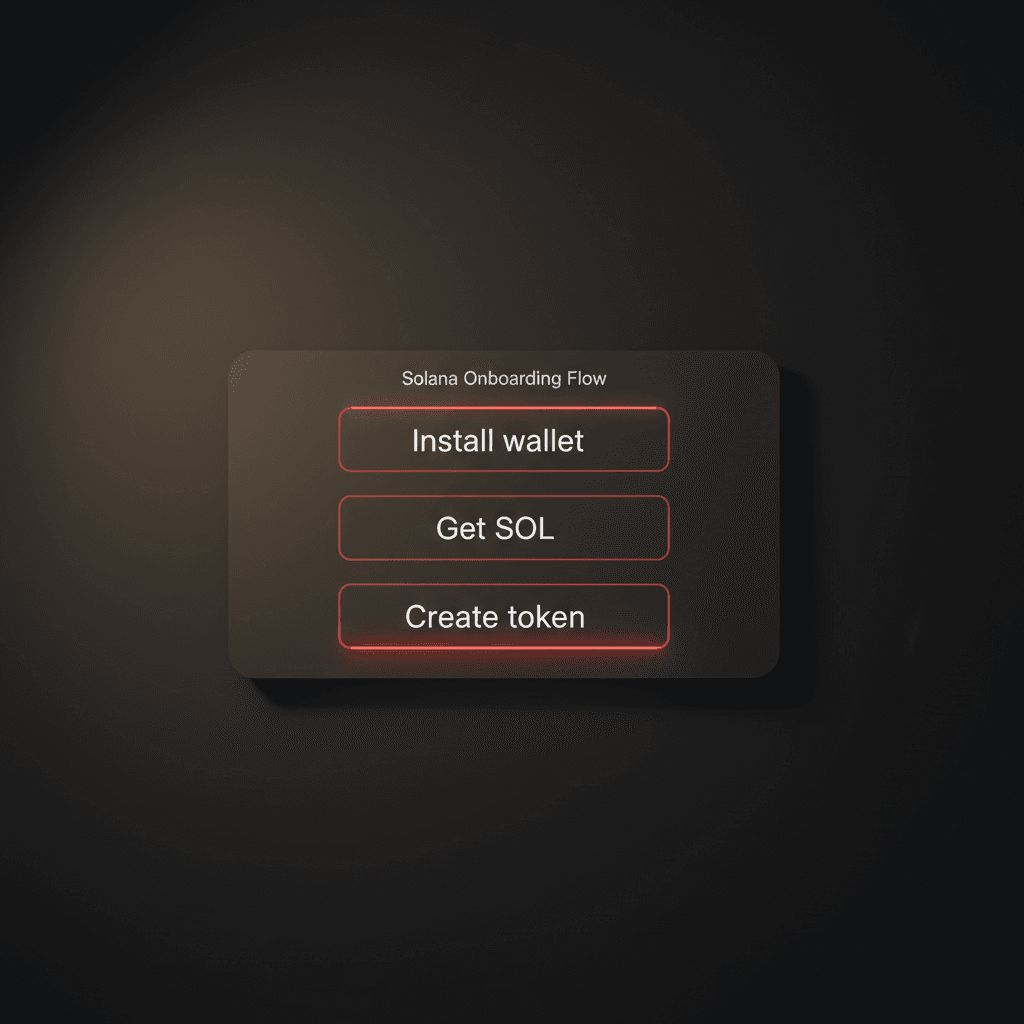
The Solana token creator tool mints an SPL token from a single form. Set name, symbol, decimals (usually 9), initial supply, upload an image, connect a wallet, sign once. About 0.025 SOL, on-chain in two seconds. For step-by-step guides, see the Solana tutorials category.
6. What is Pump.fun and how does it work?
Pump.fun is the most popular Solana memecoin launchpad. Tokens launch on a bonding curve, and price rises with supply via a fixed formula. Once the curve hits ~85 SOL, the token graduates to PumpSwap, Pump.fun's own exchange. The Pump.fun token creation tool handles bonding-curve launches.
7. What is mint authority and why revoke it?
Mint authority is the only account allowed to mint new supply. While it's open, the owner can dilute supply at any time, which kills holder confidence. The Solana mint authority revoke tool closes that door permanently. Action is one-way, so it lands after the final supply is set.
8. How do I open a liquidity pool?
For a token to be tradable, a DEX pool needs to exist. Raydium is the most common choice. The Solana liquidity create + buy tool opens a Raydium V4 pool and places the first buy in the same bundle. One form: token mint, initial liquidity (SOL + token amounts), optional first buy.
The rest of the ecosystem
9. What is a Solana NFT, and how does it differ from an SPL token?
An NFT is also an SPL token, but supply is 1 and decimals are 0. Through the Token Metadata standard, a unique image and attribute set get attached. Metaplex Core or Token Metadata are the most common standards. NFT minting uses the Metaplex SDK; standard SPL tokens go through J Tools in one form.
10. How much does Solana staking yield?
Solana staking yields roughly 6-8% APY on average. Liquid staking protocols (Marinade, Jito, Blaze) wrap your stake into a tradable token so you keep liquidity. Validator choice influences APY; commissions typically run 0-10%.
11. What is the difference between Solana mainnet and devnet?
Mainnet is the live economic network. Devnet is the test environment where SOL is free, but it has no real value. New projects test on devnet, then deploy to mainnet for the actual launch. The Solana devnet faucet tool gives you free devnet SOL so the whole flow can be tested at zero cost.
12. How should I pick a Solana RPC provider?
The public RPC (api.mainnet-beta.solana.com) is rate-limited and not enough for serious workloads. Paid providers (Helius, QuickNode, Triton) come with webhooks, indexers, and managed rate limits. Plans run from $0 to $100+/month; the Helius free tier is enough to start.
13. Is Phantom safe?
Phantom itself is well-built; user error is the dominant risk. Never share your recovery phrase, never sign blind from unknown DApps, never click phishing tokens. When unknown tokens land in your wallet, the SPL token close account tool sweeps the empty ATAs.
Not getting caught
14. What is a Solana airdrop and how do I get one?
An airdrop is when a project distributes free tokens to its holders or active users. Eligibility usually requires wallet activity by a snapshot date, holding duration, or event participation. To run your own airdrop campaign, the Solana multi-sender tool distributes from a CSV list in bulk.
15. Is this Solana token a rugpull? How do I tell?
Open mint authority, open freeze authority, LP that hasn't been burned or locked, top 10 holders carrying 50%+ of supply. When these signals stack, the rugpull risk is high. The Solana token snapshot tool pulls a live holder list and distribution scan. For an 8-point checklist, see the Solana token guides category.
What's next
These 15 answers cover what most newcomers run into in their first week. For deeper material, the Solana tag page has tutorials and analysis. The full Solana tool catalogue is at J Tools all tools.
Moving tokens around
16. How do I move tokens across many wallets at once?
The single-wallet send in Phantom is fine for one transfer, but it falls apart once you have a list. Two patterns cover almost every bulk job. To pay out from one wallet to many addresses, the many-to-many transfer tool reads a CSV of address and amount pairs and sends them in batched transactions, so a payroll or distribution run signs in a few clicks instead of one transaction at a time.
To go the other way and pull scattered balances back into a single wallet, the multi-wallet collector tool sweeps SOL or SPL tokens from many source wallets into one destination. Both run from your browser and never ask for a private key beyond what the connected wallet signs.
Sending small amounts to wallets that hold zero SOL? The receiving wallet still needs a token account, and creating one costs a small amount of rent in SOL. Budget for that when you size an airdrop, or the last transfers can fail mid-batch.
17. How do I swap one Solana token for another?
A swap trades one token for another at the current market price through a DEX. On j.tools the Solana swap tool routes the trade and shows the expected output and price impact before you sign. Price impact is the slippage you pay for moving the pool, so a thin pool punishes a large order more than a deep one. Set a slippage limit you are comfortable with, check the route, then confirm in your wallet. The token never leaves your custody until you sign the transaction yourself.
Still have Solana questions?
These cover the Solana questions we get asked most, but Solana moves fast and new ones come up every week. The j.tools blog archive goes deeper on launches, liquidity, and token safety, and every tool page has its own short guide explaining exactly what the tool does and what the current fee is. Start there when you need the detail behind a one-paragraph answer.
Go deeper on the common questions
Use the 30-term Solana glossary when a definition is unfamiliar, follow the SOL transfer guide from Binance to Phantom for wallet funding, and learn how to close empty token accounts and reclaim SOL.