Solana Glossary: 30 Essential Terms You Need to Know
Solana glossary: 30 core terms explained. Mint, ATA, lamport, slot, epoch, validator, rent, bonding curve, LP and AMM, each in plain language.

If you're new to Solana, the terminology hits hard at first. Mint, ATA, lamport, slot, epoch, validator, rent. None of it self-explains. This Solana glossary is the 30-term cheat sheet you need to navigate the ecosystem. For each term: a plain explanation, the J Tools tool that uses it (when applicable), and where you'll see it in practice. From creating a token to running a bot to managing a wallet, these terms come up everywhere.
The Solana glossary below is grouped the way the network is actually built, so you can read it end to end or jump to the part you are stuck on:
- Terms 1 to 7 cover the token itself: the mint, its authorities, and the accounts that hold a balance.
- Terms 8 to 15 cover the network: lamports, slots, epochs, validators and staking.
- Terms 16 to 23 cover what a transaction costs and how it is built.
- Terms 24 to 30 cover trading, launches and the tools you read them with.
1. SPL Token
Solana's token standard. The Solana equivalent of ERC-20, except you don't write a smart contract. The SPL Token program runs the same logic for every token. To create one, the Solana token creator tool takes every parameter in a single form.
2. Mint Account
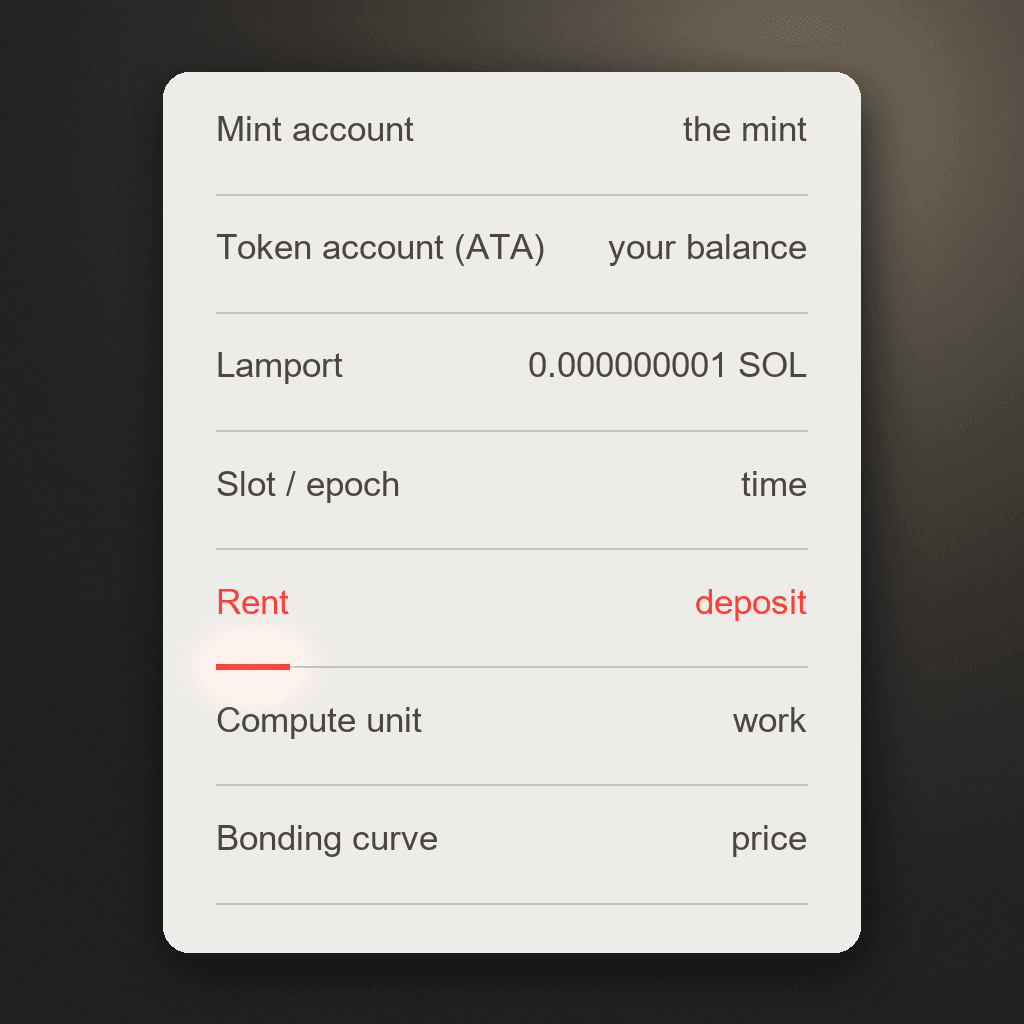
A token's "birth account". It stores total supply, decimals, mint authority, and freeze authority. The mint address is the unique identifier for the token.
3. Mint Authority
The single account allowed to mint new supply. While it's open, the owner can dilute supply at any time. For holder confidence, it's permanently revoked. The Solana mint authority revoke tool does it in one form. The action is one-way.
4. Freeze Authority
The authority that can freeze a holder's wallet. While it's open, the owner can lock your account at will. The Solana freeze authority revoke tool closes that door permanently.
5. Update Authority
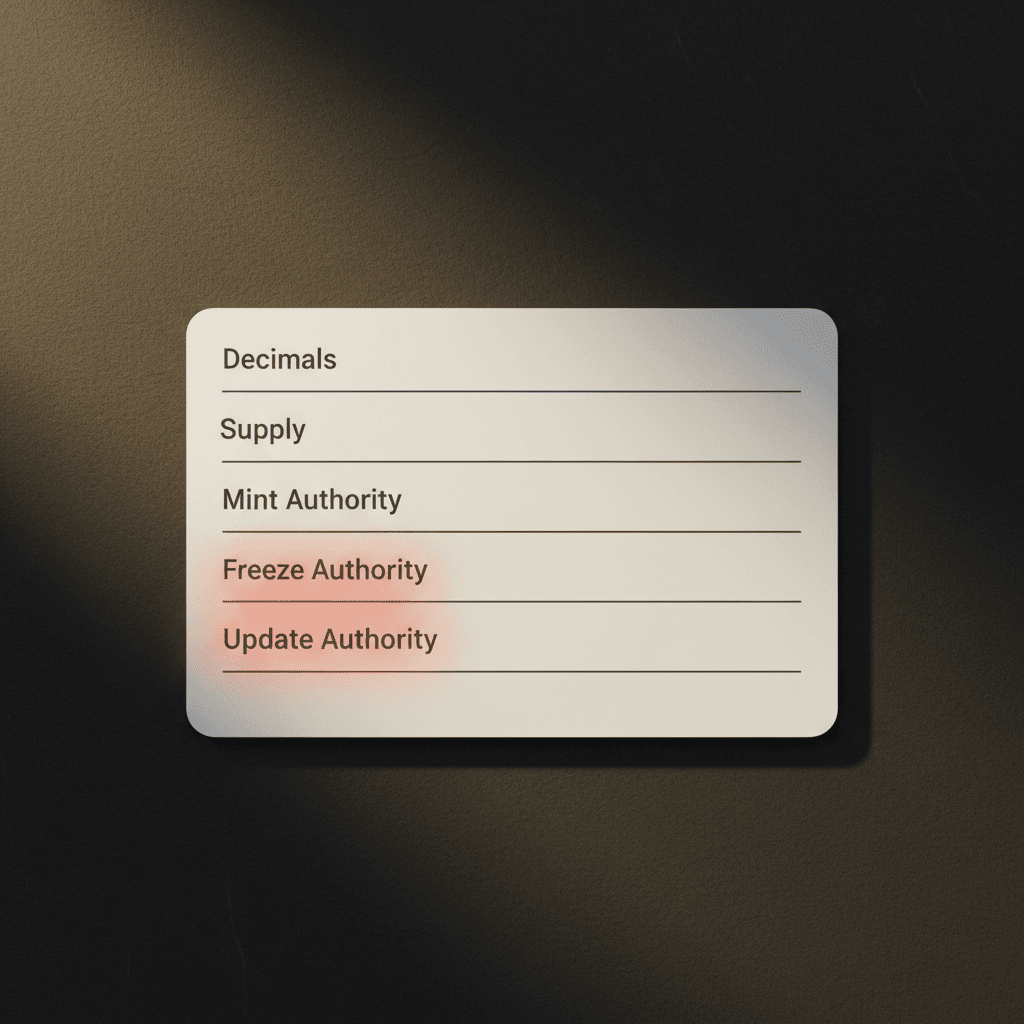
The authority that can change metadata (name, symbol, image, URI). While it's open, the token can effectively rebrand into something else. The update authority revoke tool locks it in place.
6. Token Account
An account that records how much of a specific token a wallet holds. Each wallet + token pair has its own account.
7. ATA (Associated Token Account)
The standard token account derived deterministically from a wallet + mint address pair. 99% of Solana token transfers go through ATAs. ATAs auto-create on first transfer, costing about 0.002 SOL in rent.
8. Lamport
The smallest unit of SOL. 1 SOL = 1,000,000,000 lamports. All fees are calculated in lamports under the hood; the UI converts to SOL.
9. SOL
Solana's native token. Used for network fees, rent deposits, staking, and Token-2022 transfer fees on extensions.
10. Slot
The smallest time unit on Solana, roughly 400ms. Each slot has a designated leader validator that confirms transactions for that slot.
11. Epoch
A full cycle of 432,000 slots (~2-3 days). Stake rewards distribute at epoch end, validator scores recalculate.
12. Validator
Servers running the Solana network. Becoming a validator requires 12,000+ SOL stake and dedicated hardware. Rewards distribute per epoch.
13. Leader
The validator authorised to confirm transactions for a specific slot. The leader schedule sets at the start of each epoch, slot allocation is proportional to stake.
14. Stake
Delegating SOL to a validator to support network security and earn rewards in return. Solana staking yields roughly 6-8% APY.
15. Delegation
The process of pointing your stake at a specific validator. Delegation activates one epoch after the action, then starts earning rewards.
16. Rent
SOL locked up to keep an account on-chain. Returned when the account closes. The SPL token close account tool sweeps unused ATAs and reclaims their rent.
17. Compute Unit (CU)
The work-budget for a transaction. Default 200K, max 1.4M CU. Complex transactions need an explicit CU-increase instruction.
18. Priority Fee
An extra fee paid to get your transaction processed faster during congestion. Calculated in lamports per CU.
19. Versioned Transaction (v0)
Solana's modern transaction format. Supports Address Lookup Tables, so a single tx can reference hundreds of accounts. Modern SDKs default to v0.
20. Address Lookup Table (ALT)
A table that compresses frequently-used account addresses. ALTs in v0 transactions shrink the tx size and let more operations fit.
21. PDA (Program Derived Address)
An address derived deterministically by a Solana program. No private key, so only the program can sign. Used heavily in cross-program invocation.
22. Anchor
The most common framework for writing Solana programs. Generates an IDL (interface description), callable from client-side TypeScript.
23. Solana Program
A smart contract on Solana. Stateless execution; data is stored in PDA accounts, which is exactly what makes parallel execution possible. Most programs are written with Anchor, and the details live in the official Solana documentation.
24. Bonding Curve
The pricing mechanism Pump.fun-style launchpads use to set token price by supply. Buy price rises as supply increases. The Pump.fun token creation tool launches in bonding-curve format.
25. AMM (Automated Market Maker)
A DEX model that uses liquidity pools instead of an order book. Raydium, Meteora, Orca are AMMs. Pricing is formula-based (x*y=k or similar).
26. LP (Liquidity Provider)
Someone who deposits two tokens proportionally into an AMM pool. They receive LP tokens in return and earn a share of swap fees. The Solana liquidity create + buy tool opens a Raydium pool from one form.
27. Pump.fun
The most popular Solana memecoin launchpad. Launches via bonding curve, graduates to PumpSwap, Pump.fun's own exchange, when the curve fills around 85 SOL. For bonding-curve mechanics, the Solana token guides category covers it in depth.
28. Jito Bundle
A Jito MEV protocol feature that runs multiple transactions atomically. Used for sandwich-attack protection or coordinated multi-step actions. Bundles route through Jito-Solana validators on a private mempool.
29. Solscan / Solana Explorer
The on-chain data explorers for Solana. the Solscan block explorer is the standard for tx detail lookup, holder list export, and mint authority verification.
30. Helius / RPC Provider
An RPC endpoint provider that connects you to the Solana network. Helius, QuickNode, and Triton are the most common. Public RPCs are rate-limited; serious workloads need a paid plan.
How to use this Solana glossary
These 30 terms cover the foundation of the Solana ecosystem, and a glossary is worth more when you use it against a real token rather than reading it once. To start creating tokens, the Solana token creator is the first stop. For wallet generation, the Solana wallet generator tool. More guides on the Solana tag page; the full tool list lives at J Tools all tools.
Solana terms FAQ
The same handful of terms trip up almost everyone in their first week. Here are the short, accurate answers people actually search for.
What is a lamport on Solana?
A lamport is the smallest unit of SOL, the way a satoshi is the smallest unit of Bitcoin. One SOL equals 1,000,000,000 lamports. Network fees are tiny, often a few thousand lamports, which is why you see numbers like 0.000005 SOL rather than whole coins. The name honours Leslie Lamport, whose research underpins distributed consensus.
What is an ATA (Associated Token Account)?
An ATA is the specific account that holds one token for one wallet. Its address is derived from your wallet address plus the token mint, so the same pair always produces the same ATA. The first time someone sends you a new token, the ATA gets created and a small rent deposit (about 0.002 SOL) is locked to keep it on-chain. That deposit is yours, and you get it back when you close the empty account.
What is rent and can I get it back?
Rent is the SOL an account locks to stay stored on-chain. It is a deposit, not a fee, so it comes back in full when the account is closed. Wallets that have traded many tokens often hold a pile of empty ATAs, each sitting on roughly 0.002 SOL. Sweeping those accounts reclaims the locked SOL, which is exactly what the close account tool handles in one pass.
What is a bonding curve?
A bonding curve is a formula that sets a token's price directly from how much of it has been bought. Early buyers pay less, and each purchase nudges the price up along the curve. Pump.fun-style launches use this so a token can trade the moment it exists, with no liquidity pool to seed. Once enough is bought, the token graduates to a real AMM pool and normal swap pricing takes over.
What is the difference between a mint account and a token account?
The mint account is the token; the token account is your balance of it. There is exactly one mint account per token, and it stores the supply, the decimals and the authorities. There is one token account per wallet per token, and it stores nothing but how much that wallet holds. Reading the mint tells you whether a token is safe; reading a token account tells you who owns what.
Do I need to know these terms before launching a token?
You need about eight of them: mint account, decimals, supply, the three authorities, rent and priority fee. Those are the fields a launch form asks you to set, and the ones a buyer checks afterwards. The rest of this Solana glossary becomes useful the moment something goes wrong, which is usually when a transaction fails or a balance does not appear.
A few terms worth a second look
Some entries above are easy to read past, yet they decide whether a transaction lands or fails.
Slippage is the gap between the price you expect and the price you actually get when a swap executes. On a fast-moving token, the pool can shift between the moment you sign and the moment the transaction confirms. Set the tolerance too tight and the swap reverts; set it too loose and you overpay. The Solana swap tool lets you pick that value per trade so you stay in control.
Jito bundle means several transactions submitted as one atomic unit through Jito's private path. Either every transaction in the bundle lands together in the same block, or none of them do. That all-or-nothing guarantee is what makes coordinated actions, like buying across many wallets at once, behave predictably instead of half-filling. The bundled trade tool uses this to fire a multi-wallet buy or sell as a single bundle.
PDA (Program Derived Address) is an address that belongs to a program rather than a person. It has no private key, so nobody can sign for it by hand; only the owning program can authorise actions on it. This is how Solana programs hold state safely, since a PDA cannot be drained by a leaked key the way a normal wallet can.
Before you trust any new token, read its mint on an explorer and check that mint and freeze authority are revoked. A Solana glossary tells you what the fields mean; the on-chain record tells you whether they are actually safe.
Put the terminology into practice
After the definitions, work through the 15 most-asked Solana questions, clarify valuation with the FDV and market cap calculation guide, and understand address generation in the Solana vanity wallet and mint guide.