Universal Bundled Sell: Coordinated Exits on Pump.fun
Sell across many wallets in one atomic Jito block: when a coordinated bundled exit beats a delayed multi-swap, the operator cases, and how the market reads it.

If you ran a launch on Pump.fun or a similar platform with five wallets that all bought into the token at the same moment, you already know what the exit looks like when it goes wrong. The wallets sell one by one, the price slips on every transaction, and the last wallet to leave gets a price far below what the first one received.
Worse, a handful of outside actors squeeze in between your sells and skim the difference for themselves. A bundled sell closes that whole window. Think of a concert ending and the security crew opening every exit door at the same second; the crowd flows out clean, nobody gets crushed, and there is no time for pickpockets working the line.
Same mechanic, different optic
The core of a bundled sell can be stated in one line. You take the sell action from many wallets, wrap them into a single package, and hand the package to the network.
The network either accepts the whole thing and lands every sell in the same block, or it rejects the whole thing and nothing happens; Jito's bundle documentation states that all-or-nothing rule directly. Nobody else can wedge a transaction between your wallets to skim a price difference. It is the exact same technique that bundled buy teams already use at launch, just pointed the other direction.
Say you launched a token with five wallets that all bought during the opening seconds. You hit your target profit level and now you want all five wallets to take their gains at the same block, without any of them front-running each other.
If you sell them one at a time, the fourth wallet eats the price drop from the third, the fifth wallet eats both, and the gap between the first and the last reads on the price chart as a stair-step you created yourself. A bundled exit compresses that stair-step into a single step.
The real difference is not in the mechanic but in how the action reads to anyone watching from the outside. A package of twenty buys in one block can be framed as a team buying back or a treasury rotating in, which the market sometimes welcomes. A package of twenty sells in the same block reads as a coordinated exit, even when the twenty wallets belong to twenty different operators each taking profit independently. The chain does not know intent. It only sees direction, and the community reads that direction with its own eyes.

Three differences between bundled buy and bundled sell
The mechanic is symmetric. The downstream reaction from the market is not. Three things invert when you flip the direction.
Price impact runs against you in series. In a bundled buy, the first wallet fills at the best price and the last wallet pays the worst. In a bundled sell, the first wallet sells into the deepest part of the pool and the last wallet sells into a shallower, already-drained pool. Ordering matters in both cases. The cost asymmetry just runs the opposite way.
Liquidity drains rather than fills. A bundled buy adds funds to one side of the pool and deepens one leg of the pair. A bundled sell pulls funds out of the pool and leaves the post-bundle pool thinner than before. The next buyer faces a wider spread. This is the worst part of the optic, because a thinner pool is visible to anyone scanning the pair on any explorer.
The optic flips from welcome to suspect. A coordinated buy gets framed as conviction. A coordinated sell gets framed as fleeing. The mechanic neither knows nor cares which it is. Anyone reading the on-chain history after the fact does care, and they will read the second one harder than the first.
A bundled sell that takes a meaningful slice of pool depth in one block drains liquidity instantly. The next buyer faces a wider spread, the pair looks thinner on every scanner, and the visual reads as a dump even when the intent was disciplined profit-taking. Plan the size against pool depth, never against ego.
When bundled sell is the right call
Three operator cases earn the use of a bundled sell. Anything else probably belongs in a different tool.
Coordinated take-profit at a target. A team that ran a coordinated buy package at launch and now wants to exit those same launch wallets at a coordinated profit level. The exit is symmetric to the entry. The team has already chosen to act as one group on the entry, so acting as one group on the exit is consistent. The optic is still loud, but the framing matches.
Treasury unwind on a published policy. A project community votes to liquidate a portion of a treasury position at a stated trigger. The operator wants to execute the vote cleanly, in one block, without printing a long single-wallet sell tape that invites front-running over the next ten minutes. The vote is the communication, the bundle is the execution.
Session-end wallet retirement. A sniper or farming operator running a multi-wallet position at the end of a session wants to unwind all of them at once. Spreading the exit over time means each later wallet gets a worse price and exposes the operator to outside actors wedging between sells. Atomic ordering closes both holes at once.
Alternative: multi-swap with a delay
The alternative when you want the same outcome with a different visual is the delayed multi-swap tool. The delay setting between wallets spreads the same set of sells across many blocks, five to fifteen seconds apart. Each wallet reads as independent to a casual observer. The trade-off has two parts.
First, the price drifts down between wallet one and wallet two hundred. The last wallet fills at whatever the pool gives it after every earlier wallet has already sold. Second, the gap between wallets opens a window for outside actors to take a bite. The single-block protection is gone.
This is the choice operators have to make explicitly.
| Approach | Single block? | Market reading | Outside-actor risk | Cost profile |
|---|---|---|---|---|
| Bundled sell in one block | All-or-nothing in a single block | Reads as coordinated exit | Zero outside risk | Flat fee plus a network priority tip |
| Multi-swap with delay | Independent across many blocks | Reads as scattered organic sells | Open window between wallets | Small fee per transaction, no tip |
| Single-wallet sequential sells | One transaction at a time | Reads as a long single-wallet tape | Highest outside-actor risk | Network fees only |
If the operator group can defend the coordination publicly, pick the bundle. If the goal is to hide that the wallets belong to the same operator, pick multi-swap with a delay. Picking both for the same position is incoherent.

Step by step on j.tools
The Bundled Trade terminal runs this flow today: pick sell mode for an exit, and the same screen runs the buy side when you need the mirror image.
The flow mirrors the bundled buy flow with the direction reversed.
- Load the wallet list. Each wallet must hold a balance of the target token and enough funds to cover its own transaction fee.
- Set the token address. The same address applies to every wallet in the bundle.
- Set the per-wallet sell amount. Mixed sizes are allowed; some wallets can sell half their balance while others sell everything.
- Set the slippage cap. Two percent is a reasonable starting point for a deep pool; thinner pools need a wider cap or the bundle reverts at the last wallet.
- Set the priority tip. A higher tip means the bundle is more likely to land in the next block. Read the current tip floor before submitting.
- Submit. The network either lands all sells in one block or rejects the whole bundle.
For a position that mixes buys and sells in the same atomic group, an upper-level tool exists for that case, but it is out of scope for most readers.
Post-exit cleanup
After the bundle lands, each wallet holds the funds from the sale plus, in some cases, a small dust balance of the token. The cleanup chain is short.
Consolidate the funds into one operator wallet with the batch fund collector tool. That sweeps proceeds from every wallet in one pass and saves the cost of running two hundred individual transfer steps. Close the empty token accounts to reclaim the small deposit locked inside each one.
Two hundred closed accounts recover a meaningful sum. Verify the final balances on-chain with the token holder snapshot tool against the operator wallet list before declaring the position closed. For more walkthroughs in this pattern, browse the j.tools guides category and the surrounding posts in the Pump.fun tag list.
Failure modes and the optics question
Three things make a bundled sell fail or land badly. If the tip is too low, the network drops the bundle and none of the sells execute. The pool moves against the operator while they retry, and the second attempt fills at worse prices. If the pool depth is too shallow for the bundle size, the last wallets in the bundle hit a pool that has already been drained by the earlier wallets, and they revert against the slippage cap.
If one wallet reverts, the whole bundle reverts. If the slippage cap is too tight, one wallet's actual slippage exceeds the cap and the same thing happens. Picking two percent on a pool that needs four percent wastes the tip and shows up as nothing happened on screen.
Publish the exit policy before the bundle lands. A team that has stated "we will exit treasury position X at price Y" and then runs a coordinated sell at Y reads as disciplined. A team that goes quiet for a week and then prints a bundle of two hundred sells reads as fleeing. The on-chain mechanic is the same. The framing is operator-side communication.
Bundled sell is a clean execution tool with a loud on-chain signature. That is the whole tension of the tool. The mechanic protects the operator from outside actors squeezing in. The optic exposes the operator to community reading. There is no way to have both. What an operator can control is the framing around the execution. A bundle that follows a public policy reads one way. A bundle that arrives out of nowhere reads the other way. The execution code is the same. The chain does not know which one it is showing.
Before pressing submit, the question to answer is not "can I do this cleanly", because the bundle takes care of cleanly on its own. The real question is whether the audience has been told this was coming. If yes, run it. If no, either run it anyway and own the optic, or switch to the single swap tool and exit one wallet at a time at a smaller size and accept the drift cost as the price of a softer signature.
Bundled sell on Raydium and PumpSwap, beyond Pump.fun
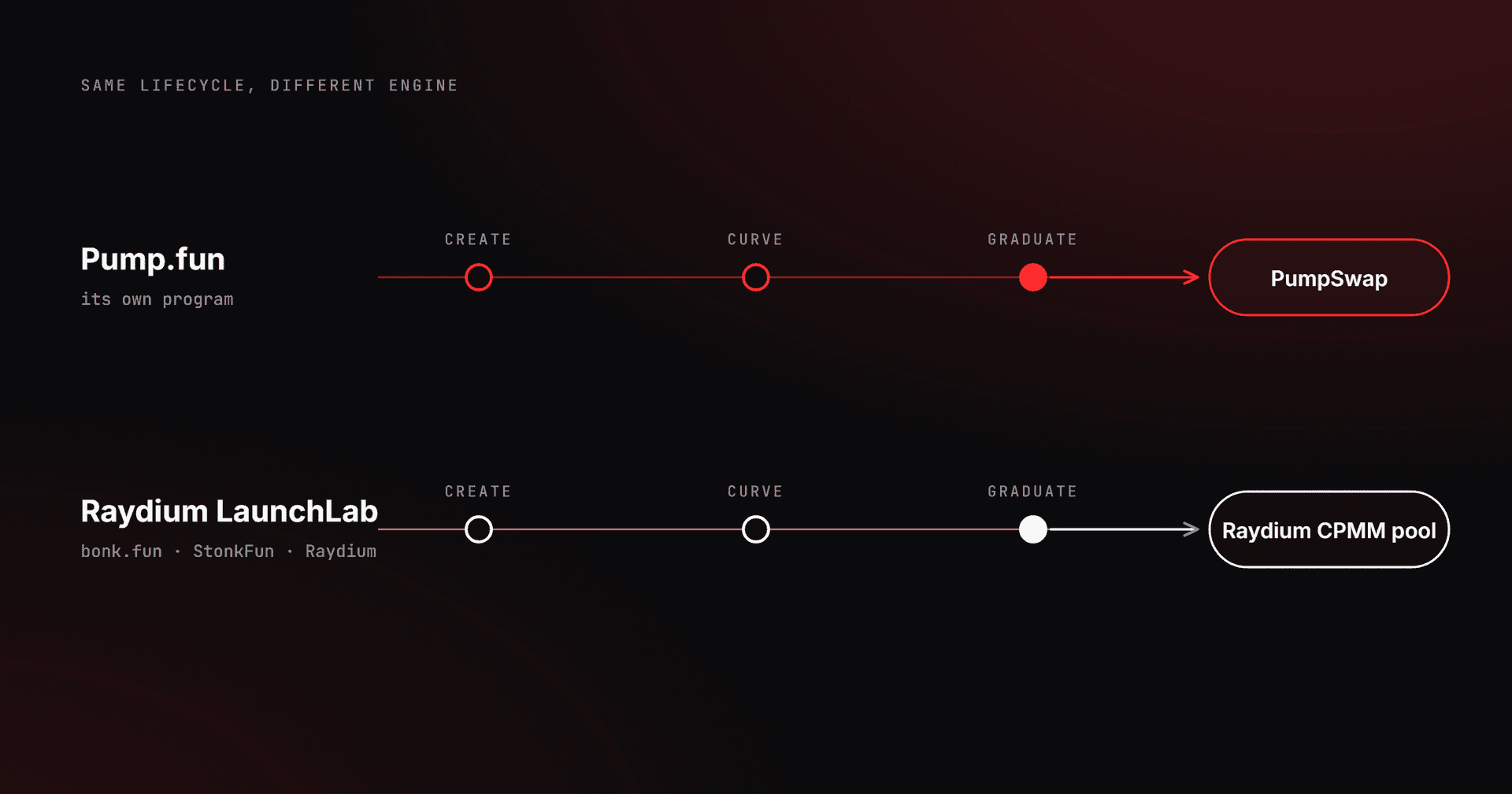
The launch-wallet story above uses Pump.fun because that is where most coordinated buys start, but the mechanic has nothing to do with Pump.fun specifically. A bundled sell works against any pool the wallets can trade into. Once a token graduates off the bonding curve, it lives in a standard AMM pool, and that is the pool every sell in the bundle routes through.
Three route cases cover almost everything operators run into:
- Still on the Pump.fun curve. The token never migrated. Each sell trades back against the bonding curve, and depth is set by the curve formula rather than by deposited liquidity. Curves recover price faster than a thin AMM pool, so the post-bundle optic is softer here.
- Migrated to PumpSwap. After graduation, Pump.fun tokens land in a PumpSwap pool. Sells route through that pool, and a fraction of these pools are Token-2022 mints with transfer hooks, so confirm the program before you size the bundle.
- Live on Raydium. A token with a Raydium AMM or CPMM pool sells against that pool's reserves. Depth is whatever liquidity providers have parked there, which is the number that actually caps how large a bundle the pool can absorb without a brutal stair-step.
Before sizing any exit, look at the live pool, not the launch. Open the My Pools dashboard or a holder snapshot to see current reserves on the route the token actually trades on. A bundle sized against last week's depth reverts at the last wallet or carves a chart that reads worse than the sells deserved.
Bundled sell vs selling one wallet at a time
Most operators reach for a bundle after a manual exit went badly, so the honest comparison is against selling each wallet by hand, one transaction after another. The bundle wins on two axes and loses on one.
- Optics. A sequential manual sell prints a long tape: wallet one, then wallet two ten seconds later, then wallet three. To anyone watching, that reads as the same hand selling over and over, which is the loudest possible signal. A single-block bundle compresses the whole thing into one print. Louder per-block, but over in one block instead of ten minutes of bleeding.
- Slippage. Selling by hand still drains the pool in series, so the later wallets fill into a thinner pool exactly as they would in a bundle. The difference is that manual selling adds dead time between wallets, and the pool can move against you in that gap on its own. The bundle removes the gap.
- Outside-actor exposure. This is the real gap. Every pause between manual sells is an open window for an outside actor to wedge a transaction in and skim the price difference. A bundle lands all-or-nothing in one block, so there is no window to exploit. Selling by hand leaves that window open on every single wallet.
- Cost. Manual selling pays only network fees per transaction. A bundle adds a network priority tip on top, because that tip is what buys the single-block guarantee. You pay the tip to close the windows the manual path leaves open.
The rule of thumb: if the wallets clearly belong to one operator and hiding that is pointless, bundle and get it over with. If you genuinely need the sells to look unrelated, neither the bundle nor a fast manual sweep helps you, and a delayed sweep with the Multi Swap tool spread across blocks is the only honest tool for that goal.
Common questions
Can I bundle-sell on Raydium?
Yes. The bundle does not care which AMM the pool lives on. As long as every wallet can route a sell into the same pool, Raydium, PumpSwap, and the Pump.fun curve all work. What changes between them is pool depth, and depth is what caps how large your bundle can be before the last wallets revert against the slippage cap.
How many wallets can go in one bundle?
The hard ceiling comes from how many transactions fit inside a single atomic package on Solana, so very large wallet counts get split into multiple packages rather than one. The practical ceiling is lower than the technical one: a bundle that takes a meaningful slice of pool depth drains the pool for the wallets behind it. On a thin pool, five wallets selling everything can already be too many. Size against depth, then count wallets, never the other way around.
Will a bundled sell get sandwiched?
No. The single-block, all-or-nothing landing is exactly what defeats a sandwich. A sandwich needs to slip one transaction in front of your sell and one behind it, and an atomic bundle gives an outside actor no slot to wedge into.
The trade-off is the opposite risk: a sequential manual exit is wide open to that kind of front-running on every wallet, which is the main reason operators move to a bundle in the first place. If you want both directions in one atomic group, buys and sells together, that is the job of the Bundled Trade tool rather than a sell-only bundle.
Prepare the exit around liquidity and wallets
A coordinated sell depends on pool depth, holder state, and wallet hygiene. Review the Raydium V4 pool creation workflow, troubleshoot with the 10 common token holder fixes, and use the Solana vanity address guide to understand custom wallet identities.