Pump.fun Graduation Explained: What Happens After the Bonding Curve
What the Pump.fun bonding curve is, what graduation means, and how the PumpSwap migration and burned LP shape the first hour of price.
You saw "graduated" next to a coin. What does that even mean?
Maybe you were scrolling Pump.fun, or someone on crypto Twitter mentioned a coin that "graduated," or you bought a tiny memecoin and a little "graduated" notice popped up. And you thought: graduated from what? Is that good news or a warning? This guide answers all of that in plain language, with no jargon left unexplained. By the end you will know what is Pump.fun graduation, how the Pump.fun bonding curve works, and what actually happened to your coin (and to your money) when it crossed that line.
Here is the honest headline first, and it is a striking one: only a small fraction of all coins launched on Pump.fun ever graduate. Most quietly fade toward zero. So if a coin you are holding just graduated, it already did something most coins never manage. That does not make it a winner. It just made it past the first gate. Let's walk through it step by step.
What is a bonding curve?
Every coin on Pump.fun is born on something called a bonding curve. That is a fancy name for a simple idea: a math rule that sets the price automatically. Each time someone buys, the price ticks up a little. Each time someone sells, it ticks down a little. There is no separate buyer you have to find, and no order book to match against. The rule does all the pricing on its own.
The easiest way to picture it is a vending machine. Imagine a machine selling cans of soda where the first can costs a few cents, and every can someone buys makes the next one slightly more expensive. If someone brings a can back, the price drops a bit. The machine handles every transaction by itself. It does not need a shopkeeper, and it does not need other customers in the room. It just follows its rule and quietly keeps all the money (here, the SOL it collects, SOL being Solana's coin) inside its own till.
That collected SOL matters a lot in a minute, so hold onto the image. The whole early life of a young Pump.fun coin is people feeding SOL into the vending machine to buy the coin while the machine ratchets the price up as the till fills.
A bonding curve means you never wait for another trader. The machine is always ready to buy from you or sell to you at whatever price its rule currently says.
How to read bonding curve progress on Pump.fun
Every young Pump.fun coin shows a bonding curve progress bar, usually a percentage that creeps from 0% toward 100%. That bar is a live readout of how much of the curve's sellable token supply has been bought. When it touches 100%, the curve is sold out and the coin moves on to graduation.
The number you actually want to watch is not the percentage on its own, it is the speed the bar is moving. A curve that climbed from 20% to 90% in a few minutes is being filled by a wave of fresh buying (or a cluster of coordinated wallets), and that pace rarely holds once graduation hits. A curve stuck at 60% for an hour is telling you the buying has stalled and most of these never finish. The progress bar is a momentum gauge, not a quality score.
Progress alone does not tell you who is buying. A bar racing to 100% on three or four wallets is a very different coin from one filled by hundreds of small buyers. Check the holder spread before you read too much into a fast bar.
Once a coin graduates, the curve is gone and the progress bar stops meaning anything. From that point the live picture comes from the new PumpSwap pool: its holder count, how concentrated the top wallets are, and whether early buyers are already selling. You can pull that holder breakdown for any mint, before or after graduation, with the Holder Snapshot tool to see how wide the ownership really is.
The one formula every bonding curve runs on
Under the vending-machine picture sits a single equation, the same one that runs most automated pools on Solana: x times y equals k. Here x is the SOL side of the curve, y is the coin side, and k is a fixed number locked in the moment the coin launches. The rule is that k never changes. Every buy and every sell has to keep the two sides multiplying back to the same k.
Watch what that forces. When you feed SOL in, x rises, so y has to fall by exactly enough to keep k fixed, and the coins that leave the pool are what you receive. Push more SOL in and there is less coin left on the other side, so the next buyer pays more and gets less. Nobody sets that price by hand. It falls straight out of holding k constant.
One detail trips people up. If the curve started with almost no coin and almost no SOL, the very first buy would swing the price violently. Pump.fun avoids that by seeding the curve with virtual reserves, a preset starting balance on both sides that exists only in the math, not as real deposits.
Those virtual reserves give k a sane starting value, so the first real buy lands at a reasonable price instead of an absurd one. Every standard coin launches with the same one billion total supply and the same seeding (Mayhem Mode coins are the exception), which is why two different coins climb their curves in an almost identical shape.
This equation is the engine behind everything else on the curve. The steepening you feel as a coin fills, the gap between an early entry and a late one, the reason snipers fight to land in the first block, all of it is just k staying constant while the two sides trade off against each other. The longer version, reserve numbers included, is in how the Pump.fun bonding curve works.
Why later buyers always pay more (the curve math, in plain numbers)
The bonding curve runs on the same simple rule the whole way up: the more coins the machine has already sold, the higher the price of the next coin. There is no jump at graduation, the climb is baked into every buy from the very first one. If you buy when the curve is 10% full, your coins are cheap because almost nobody has bought yet. If you buy when it is 90% full, you are paying near the top of the curve, because the price has been ratcheting up the entire way.
This is why two people can buy the same coin minutes apart and have wildly different break-even prices. The early buyer is in profit the moment a few more people buy after them; the late buyer needs the coin to keep climbing on the open market just to get back to even. The math is neutral, it does not care who you are, it only cares how full the machine was when you bought.
It also explains the snipers. Buying in the first seconds means buying at the lowest point on the curve, so bots race to be first, then sell into the people who buy later. Knowing this changes how you read a fast-filling curve: a lot of that early SOL may belong to wallets that plan to sell the instant the coin graduates.
There is no fixed dollar price on the curve. Your entry price depends entirely on how full the curve was when your buy landed, so the same coin is a different bet at 15% than it is at 95%.
If you are launching rather than buying, this is the exact reason teams plan their opening buys. Spreading a first position across several wallets in the same launch, instead of one giant buy that spikes the curve, keeps the entry price sane and the holder list less lopsided. The Pump.fun Create + Bundle Buy tool handles the create and the opening buys together, and the current platform fee is shown on the tool page.
The five phases a coin passes through before it graduates
A coin does not sit still on the curve, and it does not climb evenly either. It moves through a handful of recognizable stages between launch and graduation, and each one pulls in a different crowd. Reading which stage a coin is in tells you far more than the raw price does.
Phase 1, the launch. The coin is minted and the first buys land, almost always the creator's own wallet plus a few sniper bots that watch new mints and buy in the opening seconds. The curve is at the bottom, the price is tiny, and the market cap is a few thousand dollars. Most of what happens here decides whether anyone else ever shows up.
Phase 2, early momentum. The first outside buyers arrive, the holder list starts to widen, and a little social chatter appears. Entry prices are lowest here, because the curve is still cheap. This is also where most coins die: a large majority never get past this stretch, so a coin stalling here is the normal outcome.
Phase 3, the mid curve. If buying keeps up, the coin lands on trending feeds and bigger accounts start to notice. The curve visibly steepens now, so each buy hands over less coin for the same SOL. Volume can stay high, but the easy part is behind it.
Phase 4, the run at graduation. The curve is most of the way full and traders start betting on whether it finishes. Snipers and bots crowd back in, and the price swings hardest in this stretch, because a couple of large buys can push the curve to the finish line on their own.
Since so much can ride on a few wallets here, it helps to check whether those buyers are independent or funded from one source, which is what the Wallet Scope tool maps. The patterns worth looking for are laid out in how to check if a token is bundled.
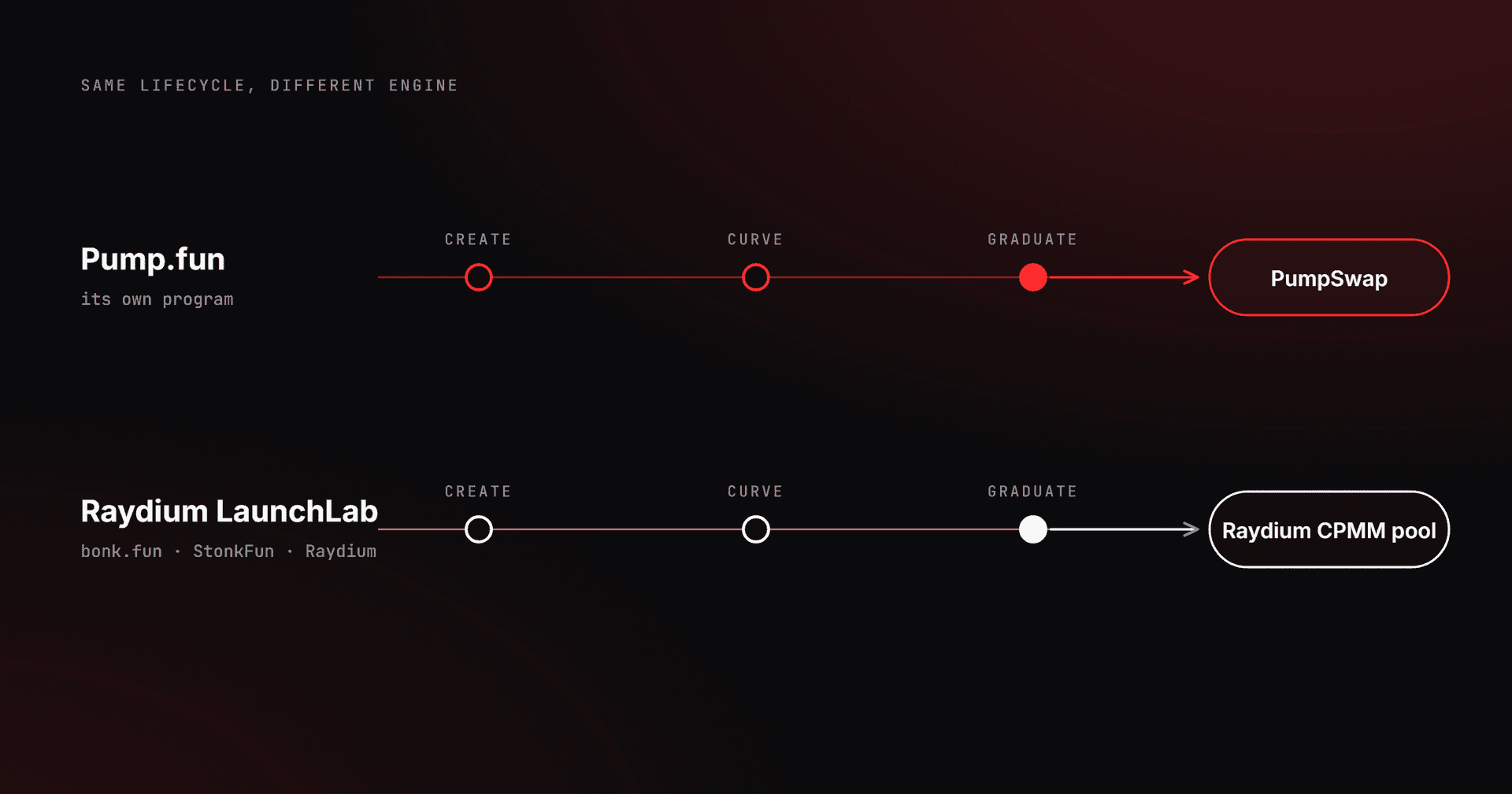
Phase 5, graduation. The curve sells out on its last buy, and a separate migration step then moves the coin from the machine to an open PumpSwap pool that anyone can trade against.
The drop-off is front-loaded. Far more coins die in phase 2 than in any later stage, so a coin that has cleared early momentum has already survived its deadliest window. That lowers the odds of a sudden death. It does not make the coin safe.
What is Pump.fun graduation, and when does it happen?
The vending machine has a limit. Once enough people have bought, the curve "fills up," and that filling-up moment is called graduation. The coin leaves the machine and moves onto a real open market where anyone can trade it freely. That is it. The coin grows up and moves out.
So what are the Pump.fun graduation requirements in 2026? A coin graduates the moment its bonding curve sells out. For a SOL-paired coin that point is about 85 SOL collected and about 793.1 million tokens sold off the curve. Since 21 May 2026 Pump.fun also has USDC-paired coins, which reach their own completion point in USDC. Here is the part almost every guide gets wrong for SOL-paired coins: the dollar number is not fixed. Their finish line is measured in SOL, not dollars, so the dollar value rises and falls with the price of SOL.
The one thing to keep in mind: for a SOL-paired coin there is no single fixed dollar price for graduation. It tracks a SOL-based finish line, so the dollar figure moves whenever SOL's price moves. Any guide that hands you one permanent dollar number is already out of date.
Remember that only a small fraction of coins ever reach this point. Most vending machines never fill up. The buyers lose interest, the till stalls, and the coin drifts down. Graduation is the rare exception, which is exactly why people make a fuss about it.
What happens at the exact moment a Pump.fun token graduates?
This is the part most people misunderstand. Graduation is not a slow process, but it is not one transaction either. The buy that sells out the curve completes it, and a separate migration instruction then moves the coin to its new pool. Three things happen:
The vending machine (the bonding curve) retires and locks its final state. No more buying or selling through the machine.
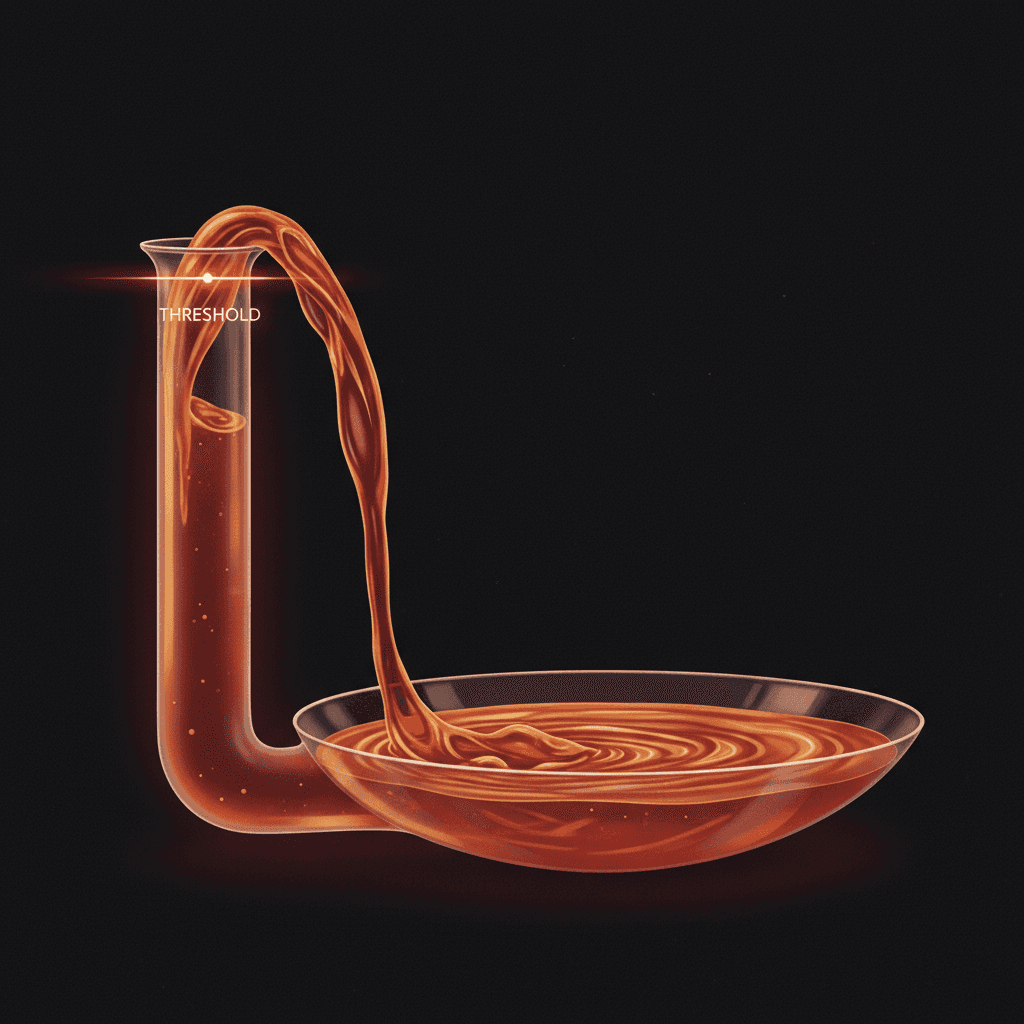
All the SOL it collected in its till, less a 0.015 SOL migration fee, plus the leftover coins, get poured into a brand-new open-market trading pool.
The receipt that proves who owns that new pool's money (called the LP tokens, short for liquidity pool tokens) is immediately burned.
Two quick glosses. "Liquidity" is just the pooled money that makes trading possible: the SOL and coins sitting in the pool so buyers and sellers always have something to trade against. A liquidity certificate (those LP tokens) is a receipt proving ownership of that pooled money.
To burn something means sending it to an address that has no key, so no human can ever retrieve it. So at graduation, the proof-of-ownership receipt for the pool gets destroyed on purpose, the instant the pool is created. We will come back to why that matters for your safety.
What is PumpSwap, and why not Raydium anymore?
The new pool that the SOL pours into lives on PumpSwap. So what is PumpSwap? It is Pump.fun's own AMM. An AMM (automated market maker) is an automatic trading pool that sets the price from how much of each coin is in the pool, with no human market maker standing in the middle. It is the same self-driving idea as the vending machine, just running an open market that anyone can trade against freely instead of a one-way launch curve.
PumpSwap launched in March 2025 and has grown into one of the largest AMMs on Solana by trading volume; our PumpSwap explainer covers how it works in more depth. In one line: it is where graduated Pump.fun coins go to trade on the open market.
You may have read older guides saying graduates move to a different market called Raydium, and that there was a 6 SOL "migration fee" (the cost of moving the coin to its new market) skimmed off the top during the move. That was true before March 2025. It is not how it works now. PumpSwap is the default destination, and the 6 SOL fee is gone. The move now costs 0.015 SOL per coin (see Pump.fun's fee page), so almost the whole till lands in the new pool, which is better for the coin's starting liquidity.
"Burned liquidity": does that mean the coin is safe?
This is where people get the most confused, so let me be careful and honest. Because the liquidity certificate was burned at graduation, nobody holds the receipt for the pool's money, which means nobody can come along later and quietly "pull the liquidity" and run off with the pooled SOL.
In crypto, when a creator yanks all the money out of the pool and leaves holders with worthless coins, that is called a "rug pull." With the certificate burned, that specific kind of rug is structurally impossible on a graduated Pump.fun coin. That part is genuinely reassuring, and it is real.
Here is the honest catch. Burned liquidity locks the pool, but it does nothing to stop the people who already hold a lot of coins from selling. The creator's wallet, early buyers, and snipers (bots that buy a coin in its very first seconds to flip it later) can all dump their coins into the new pool whenever they like. The liquidity is locked; the distribution of who owns the coins is wide open. So a graduated coin can still crash hard if a few big holders sell at once.
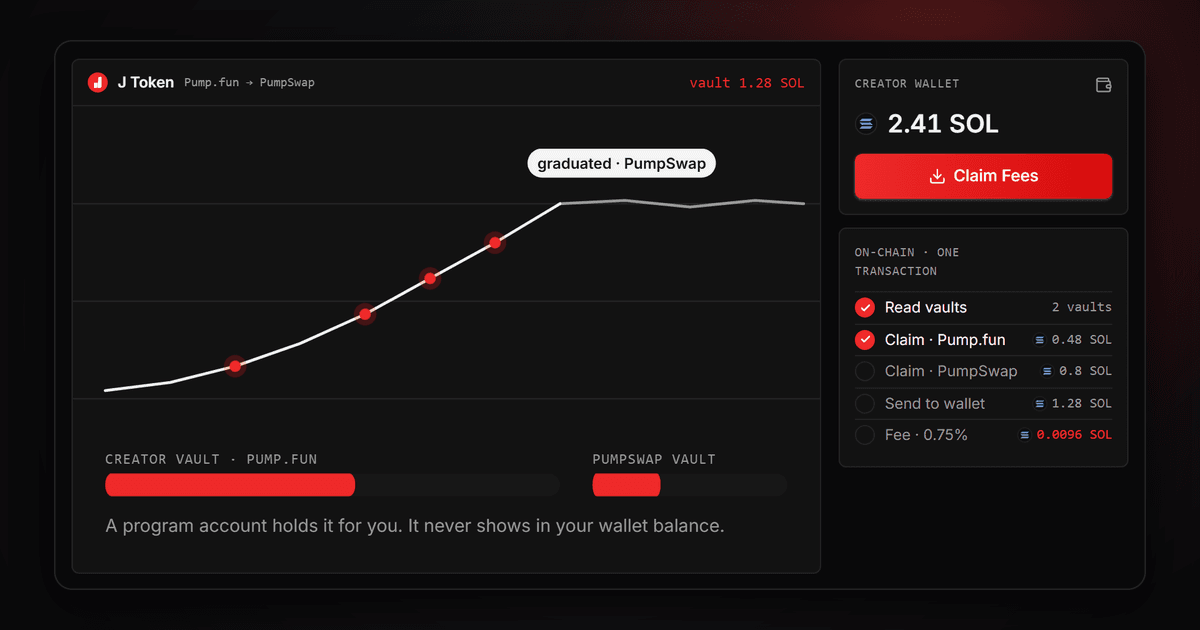
One more practical detail: not all of a graduate pool's trading fees stay locked. Since May 2025, part of every PumpSwap trade goes to the coin creator's fee vault, and the creator can claim it, for example with our Pump.fun creator fee claim tool. The LP share of the fee stays in the pool, and with the LP tokens burned nobody can withdraw it, so if you were hoping a graduate pool is a nice place to park money and earn fee income, it is a poor target for that.
Burned liquidity is not the same as a safe coin. It blocks one kind of rug only. Whales and snipers selling into the pool can still tank the price.

The first hour after Pump.fun graduation: what to expect
Say you are actually holding a coin that graduated five minutes ago. What now? Expect a roller coaster for a bit. Here is the usual pattern and why it happens.
While the coin was on the curve, selling back to the machine gave you a slightly worse price, so most early buyers just held and waited. The moment the real pool opens, that selling penalty disappears. So two things happen at once: a wave of early holders finally take profit, and fresh buyers who were waiting for a real market rush in.
The result is often a sharp spike in the first minutes, then a pullback as the early sellers cash out. Over the next 30 to 50 minutes the pool tends to settle into a calmer range.
The first ten minutes after graduation are the most volatile and the most bot-heavy window. Fast automated traders are extremely active here. If you are new, this is the worst time to chase a green candle, because the people selling into your buy are often the ones who got in for almost nothing.
How do I tell if a token graduated?
Two easy ways, one for beginners and one slightly more hands-on:
The badge. Pump.fun's own interface shows a "graduated" label on coins that crossed the line. Fastest way to know.
On-chain proof. If you want to be sure, open a free Solana explorer like Solscan or solana.fm (websites that let anyone look up what is happening on the Solana network) and look for two signs: the old bonding-curve account is emptied or marked complete, and a new PumpSwap pool is live with both SOL and the coin sitting in it. If both are true, it graduated for real.
Before vs after graduation: the simple comparison
What you care about | Before graduation (on the curve) | After graduation (open market) |
|---|---|---|
Where it trades | On the Pump.fun bonding curve (the vending machine) | In a PumpSwap pool (open AMM) |
How the price is set | A math rule: up on each buy, down on each sell | By how much of each coin sits in the pool, like any AMM |
Can you sell freely? | Yes, but selling back gives a worse price | Yes, at the live open-market price |
Liquidity-pull rug risk | Money sits in the curve until graduation | Impossible: the liquidity receipt is burned |
Who is buying | Early believers feeding the curve | Early holders selling, plus fresh public buyers and bots |
What should you do as a regular person?
Keep three things in mind. First, most coins never graduate, so seeing the badge already filters out the bulk of the dead ones, but it is no guarantee. Second, a graduate is still volatile, especially in that first hour, so do not panic-buy a candle that already ran 3x. Third, check who owns the coin before you buy.
That last point is the practical one, and it is worth doing every time. If a tiny handful of wallets hold most of the supply, that is a flashing yellow light, because those wallets can sell into the pool and crater the price. You can use the Token Holder Snapshot tool to see exactly who holds a freshly graduated coin and how concentrated that ownership is, which is one of the cleanest ways to sanity-check a graduate before you touch it.
When you actually decide to buy or sell on the open market, the one-click Swap tool routes your trade through Jupiter (a service that finds you the best price across Solana) with live price quotes and on-chain execution checks, the normal way a regular person trades a graduated coin.
If you want more grounding before you trade anything, our beginner Solana guides walk through the basics, and the Solana topic feed collects related explainers like this one in a single place.
Advanced: for people launching their own coin
Everything above was for someone trying to understand a coin they hold. This last bit is for the smaller group who want to launch one, so feel free to stop here if that is not you.
If you want to start your own coin on the curve, the Pumpfun Create launchpad tool handles a single-wallet launch with a banner upload, a USDC price quote and a pump-suffix vanity address; the current platform fee is shown on the tool page.
For a coordinated launch-day entry where you buy from several wallets in the very same block (the small batch of transactions Solana confirms together at one moment) so snipers cannot wedge in front of you, the Bundled Buy launch tool groups those buys into Jito bundles (a Jito bundle is a way to send several transactions so they land together; how many buys fit in one depends on the platform) and works across Pump.fun, PumpSwap, and Raydium, for a platform fee of 0.0035 SOL per wallet, charged only when that wallet's bundle lands.
These are advanced tools that assume you already know your way around a launch.
Pump.fun graduation FAQ
What does "graduated" mean on Pump.fun?
It means the coin filled its bonding curve. The curve collected the SOL it was built to collect, so Pump.fun closed it, opened a normal trading pool on PumpSwap, and moved that SOL into the pool. From then on the coin trades like any other token instead of on the launch curve.
How long does it take a coin to graduate, and what is the threshold?
There is no fixed clock. Some coins fill in minutes, plenty stall half full for hours, and most never finish at all. The threshold is the curve selling out: about 85 SOL and 793.1 million tokens for a SOL-paired coin, while USDC-paired coins (live since 21 May 2026) finish in USDC. For a SOL-paired coin the market-cap number it lands on moves with the SOL price. Treat any single dollar figure you see quoted as a snapshot, not a rule.
Where do graduated coins trade?
On PumpSwap, which is Pump.fun's own exchange. Graduation creates the pool there automatically and moves the curve's SOL into it, which is why the old migration step to Raydium and its 6 SOL fee are gone. The move to PumpSwap costs 0.015 SOL.
Does burned liquidity mean the coin is safe?
No. Burning the liquidity receipt means the creator cannot pull the pool out from under you, and that is worth something. It does nothing about a handful of wallets holding most of the supply and selling into you. Check the holder spread before you buy, and remember that most coins fade whether or not the liquidity was burned.
The honest close
Graduation is a real milestone, not a promise. It means a coin filled its curve, moved to an open PumpSwap market, and had its liquidity receipt burned so the classic rug cannot happen, something most coins never manage. It does not mean the price will keep climbing, and it does not stop big holders from selling into the pool. Buying a freshly graduated coin is still risky and volatile, especially in that first hour.
Before you buy any graduate, check the holder concentration first and size your buy so a sudden 50% drop would not hurt you. Take your time, and never put in money you cannot afford to lose. This is education, not financial advice.