What Is PumpSwap? How to Trade Graduated Pump.fun Coins
What is PumpSwap? Pump.fun's own DEX where graduated coins trade instead of Raydium. How graduation, buying, selling, and fees work, plus how to trade them.
You bought a meme coin on Pump.fun, the chart ran, and then a label showed up: graduated to PumpSwap. The buy button you used before is gone, the pool changed, and now you want to know where your coin went and how to trade it. Short version: PumpSwap is Pump.fun's own exchange, the place a coin trades after it leaves the launch curve, and buying or selling there is a normal swap once you know what changed.
This guide leads with the practical stuff. What PumpSwap is, how it differs from Raydium in a way you actually feel at the moment of a trade, how graduation works, and how to place a buy or sell without getting a bad fill. No jargon soup, and no promises about profit.
What is PumpSwap?
PumpSwap is Pump.fun's own exchange, its native DEX (a decentralized exchange, an on-chain marketplace where people trade tokens straight from their own wallets with no company sitting in the middle). It is where a coin trades once it leaves the launch phase, and Pump.fun built and launched it in 2025.
Under the hood it runs as an AMM (an automated market maker, the engine most DEXes use). Instead of matching a buyer to a seller through an order book, an AMM lets you trade against a shared pool of the coin and SOL, and a formula sets the price based on what is in that pool. PumpSwap uses a constant-product AMM, the same math family as Raydium's classic pools and Uniswap V2. If you have swapped on either of those, this will feel familiar.
The reason it matters right now is scale. PumpSwap went from around $1.5 billion in monthly volume in late 2025 to roughly $16 billion within about three months in early 2026, passing Raydium as the main home for freshly graduated pump.fun coins. If you trade meme coins on Solana, this is now where most fresh graduates actually change hands.
PumpSwap vs Raydium
Before PumpSwap existed, a pump.fun coin that finished its launch moved to Raydium (the big, established Solana DEX that pump.fun coins used to graduate to). Pump.fun changed that. It built PumpSwap and kept graduation in-house, so the fees and the volume now stay on its own exchange instead of going to Raydium.
For you as a trader, two differences show up at the moment of a trade. Graduation onto PumpSwap is instant and free, with none of the old migration cost. And the main liquidity for a fresh graduate now sits on PumpSwap, so that is usually where your buy or sell gets the better price.
None of this makes Raydium worse. Raydium is older and broader, it holds deep liquidity across a huge range of Solana tokens that never touched Pump.fun, and plenty of coins still trade there as their primary market. The honest takeaway is narrow. For a coin that just graduated off Pump.fun, PumpSwap is now usually where the liquidity is. For how Raydium stacks up against the other big venues, see our Jupiter vs Raydium vs Orca comparison.
| What | PumpSwap | Raydium |
|---|---|---|
| Who runs it | Pump.fun | Independent |
| Graduation fee | Free, instant | Used to be about 6 SOL |
| Best for | Freshly graduated pump.fun coins | Broad Solana tokens, established pairs |
| Trading fee | 0.25% per trade | A comparable AMM fee |
| Model | Constant-product AMM | AMM |
How graduation to PumpSwap works
Every Pump.fun coin starts on a bonding curve (Pump.fun's launch pricing machine). There is no order book. As people buy, the price steps up along a fixed formula, and it steps back down as people sell. The curve holds a set amount of the coin for sale, and our guide to the pump.fun bonding curve mechanics breaks down the exact math.
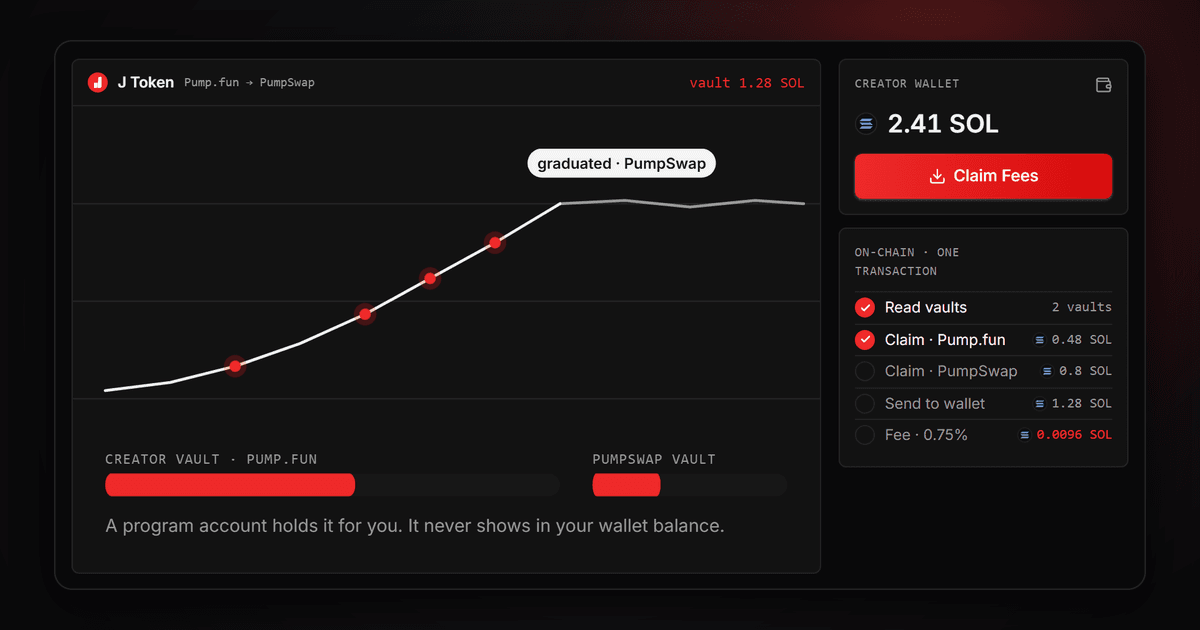
Graduation happens when that curve sells out, meaning its buyable supply has been fully bought. At that moment Pump.fun automatically creates a liquidity pool for the coin on PumpSwap (a shared pot of the coin plus SOL that lets anyone buy and sell it) and moves the SOL raised during the bonding curve straight into that new pool. It is instant and automatic, and you do not lift a finger to make it happen. For a closer look at what changes for holders, see our walkthrough of what happens after graduation.
This is the part that changed the economics. Graduating to Raydium used to cost roughly 6 SOL in migration fees. On PumpSwap that fee is gone, because Pump.fun spins up the pool itself for free.
You have probably seen graduation described as hitting a "$69,000 market cap." Treat that as a rough headline, not a fixed rule. The real trigger is the bonding curve selling out, which is priced in SOL, not dollars, so the dollar figure it lands at drifts up and down with the price of SOL. The clean way to think about it: a coin graduates when its curve sells out, whatever that works out to in dollars on the day.
How to buy and sell on PumpSwap
Once a coin graduates, trading it is a normal AMM swap. Connect your wallet, choose how much you want to trade, set a slippage tolerance, and swap SOL for the coin or the coin back to SOL. Slippage is the gap between the price you expect and the price you actually get, and it grows on a thin pool or a large order.
A few habits keep you out of trouble:
- On a thin or brand-new pool, trade a smaller amount or raise your slippage tolerance so the order can fill.
- Expect a worse price on big trades. The larger your order relative to the pool, the more you push the price against yourself.
- Check the pool depth before you commit a large buy or sell.
The Token-2022 trap
Some newer coins use Token-2022, an upgraded Solana token standard. It can carry extra rules baked into the token itself, like a transfer fee (a slice taken every time the coin moves) or a transfer hook (an added check that runs on each transfer). If your wallet or your swap tool does not support Token-2022, the trade can fail outright or land at a surprising amount.
The fix is simple. Use a tool that handles Token-2022 properly, and on any coin with a transfer fee, remember that a cut comes off each transfer, so the amount that arrives is a little less than the amount you sent, including on your buy and your sell.

PumpSwap fees and liquidity
PumpSwap charges 0.25% per trade. It splits as 0.20% to the liquidity providers (the people who deposited into the pool, also called LPs) and 0.05% to the protocol. The same setup opened the door to creator revenue sharing, so a coin's creator can earn a cut of trading activity too. Fee programs get revised, so check the current schedule in Pump.fun's own documentation before you rely on these numbers.
Here is the honest part. That 0.25% is small and rarely the thing that costs you. On a fresh graduate, the real cost is slippage against a thin pool. A shallow pool means even a modest buy moves the price, and a modest sell moves it back, so you can lose more to slippage on a single trade than you pay in fees across many. Check the depth before a big order, every time.
Deeper pool, less slippage. Thin pool, be gentle. Glance at the pool's liquidity and recent volume on a charting site before a big order, and split a large trade into smaller ones if the pool looks shallow.
Trade PumpSwap tokens with j.tools
If you want to trade graduated coins without wrestling with each pool by hand, j.tools has a few tools built for exactly this. Here is what each one actually does, with no overclaiming.
- For a single buy or sell of a graduated coin, use the single-wallet swap tool. Connect, pick an amount, set slippage, done.
- To buy or sell the same coin across many wallets at once, the multi-wallet swap tool routes trades directly through PumpSwap (and Raydium, and the pump.fun bonding curve), so you are not clicking one wallet at a time.
- To add, remove, or claim fees on a PumpSwap liquidity position, the liquidity add and remove tool supports PumpSwap pools, along with Raydium, Orca, and Meteora. It uses the PumpSwap AMM directly.
- To see all your open liquidity positions in one place, the track your liquidity positions tool lists them together.
Planning buys and sells across a group of wallets? The bundled trade tool runs a buy or a sell across many wallets by packing them into Jito bundles of up to three wallets each. Every bundle lands whole or not at all, so an exit moves in tight groups instead of wallet by wallet.

What is j.tools?
j.tools is a Solana toolkit with 40-plus no-code tools, covering swaps, multi-wallet trading, liquidity management, token creation, and more. It runs in seventeen languages, English and Turkish included. It never asks for your main wallet's private key. You connect and sign every action in your own wallet, the way you would on any DEX, so the keys stay with you. For deeper reads, browse our step-by-step Solana guides or scan everything tagged Solana.
FAQ
Is PumpSwap safe?
The exchange itself runs on standard AMM mechanics, and trading on it works like any Solana DEX. But safe to trade on is a different question from safe to buy. The pools hold real coins, most of which are meme tokens that can and often do go to zero. The venue being fine says nothing about any given coin, so do your own checks on the token before you buy.
Does PumpSwap have an API or SDK?
Because PumpSwap is a fully on-chain AMM, its pools can be read and its trades routed programmatically the way any Solana pool can, and third-party tools already do this. If you are just trading, you do not need any of that. The app, or a tool like the ones on j.tools, handles the on-chain calls for you.
Is there a PumpSwap token or coin?
PumpSwap is an exchange, not a token, so there is no coin called "PumpSwap" to buy, and you do not need to hold one to trade there. Watch out for scam tokens that borrow the name to look official. Anything claiming to be an official PumpSwap coin deserves heavy suspicion.
How is PumpSwap different from Raydium?
They are the same family of AMM under the hood, so the trading feels similar. The practical difference is where the liquidity lives. Fresh pump.fun graduates land on PumpSwap free and instantly, while Raydium is the older, broader exchange with deep pools across many non-pump tokens. The comparison table above lays out the specifics.
Can I see PumpSwap pairs on DexScreener?
Yes. PumpSwap pools show up on chart and analytics sites like DexScreener the same way other Solana pairs do, so you can watch price, liquidity, and volume there before you trade.
How much are PumpSwap fees?
0.25% per trade, split as 0.20% to liquidity providers and 0.05% to the protocol. On a small trade the fee barely registers. On a new coin, the bigger cost is usually slippage on a thin pool, not the fee itself.
Why did my pump.fun coin move to PumpSwap?
Because its bonding curve sold out. When the buyable supply on the curve is fully bought, Pump.fun graduates the coin, spins up a PumpSwap pool, and moves the SOL raised during the launch into it. The coin did not disappear. It just trades in a normal pool now, and that is expected, not a bug or a rug.
Does a coin trading on PumpSwap mean it is legit?
No. Graduating only means enough people bought the launch curve to fill it. It is not an audit, a stamp of quality, or a promise of anything. Most pump.fun coins fade or go to zero after the first rush, graduated or not, so treat a coin on PumpSwap with the same caution as any meme token.
Can I provide liquidity on a PumpSwap pool?
Yes. You can deposit into a pool and earn a share of the 0.20% LP fee, then remove or claim later. Just know that providing liquidity on a brand-new meme coin carries real risk, since the coin's price can collapse while your deposit is still in the pool.
The honest close
Graduating off the bonding curve is a liquidity event, not a safety check. Most pump.fun coins lose momentum and fade, and plenty go to zero. A coin showing up on PumpSwap tells you it filled its launch curve, nothing more. Size your trades accordingly.
PumpSwap is where pump.fun coins live after they graduate, it trades like any AMM, and the fee is a light 0.25%. The thing to respect is the pool. A thin pool means real slippage, and a graduated coin is still a meme coin that can drop fast.
Trade the size the pool can handle, check depth first, use a tool that handles Token-2022, and never put in more than you are fine losing. When you are ready, start with a single swap and scale up only once you have seen how deep the pool really is.