What Is Raydium LaunchLab? How It Differs From Pump.fun
Raydium LaunchLab powers bonk.fun and StonkFun. How its curve, graduation, fees and creator vaults work, and how it differs from Pump.fun, from live data.
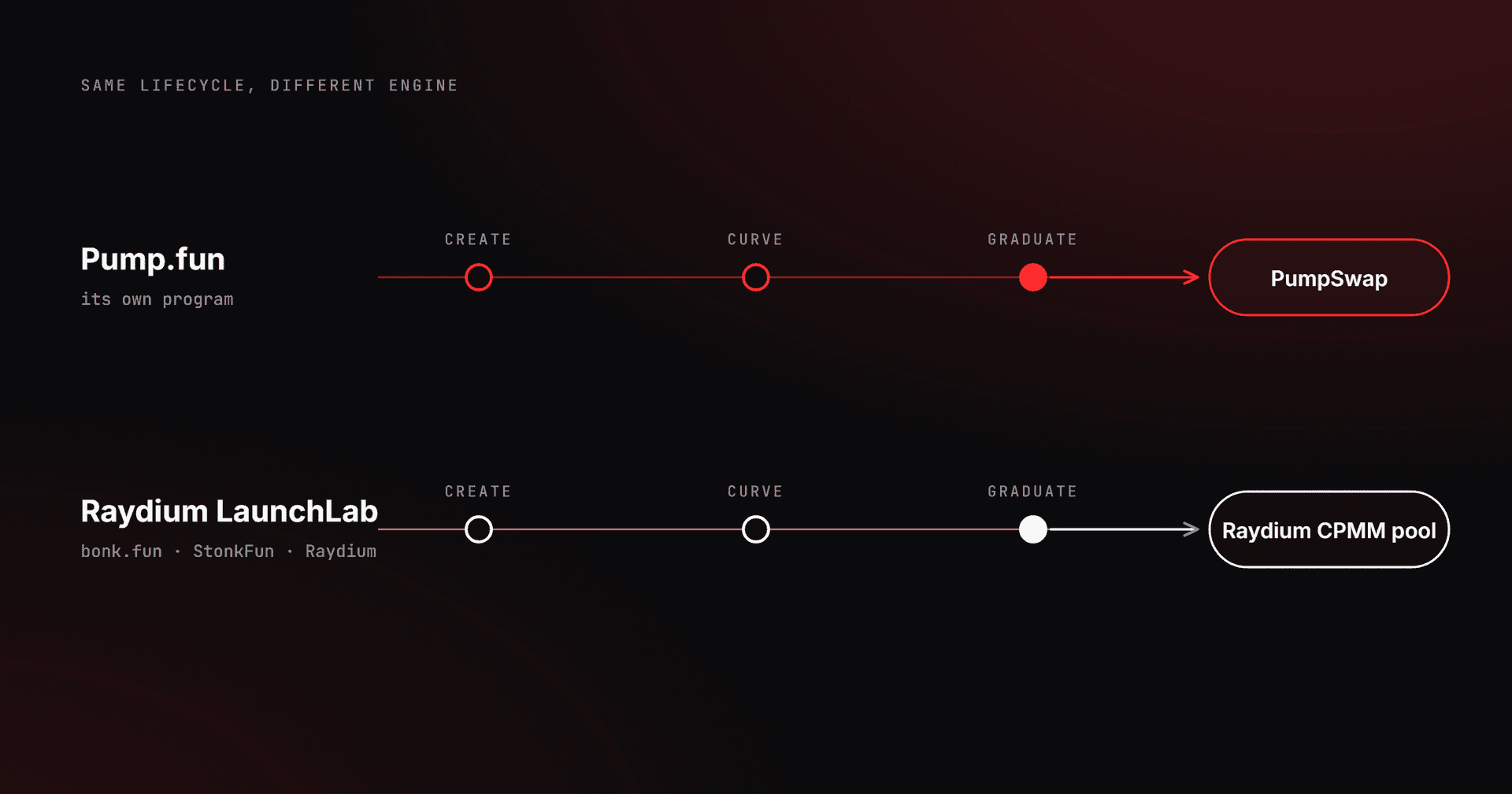
Raydium LaunchLab is a token launch program on Solana, run by Raydium. A coin starts on a bonding curve, and once buyers have filled a set target the program moves it into a regular Raydium pool. bonk.fun and StonkFun are front ends built on the same program, each with its own fees. Pump.fun is a separate program with its own curve and its own pool, PumpSwap.
This guide sets the two side by side, shows what 3,742 recent launches say about who uses Raydium LaunchLab and how, and lists the checks worth running before you buy. Last verified on 3 October 2026 against Raydium's documentation and changelog, Pump.fun's fee page (last updated 20 May 2026) and Raydium's public launch list.
Raydium LaunchLab vs Pump.fun at a glance
| Question | Pump.fun | Raydium LaunchLab |
|---|---|---|
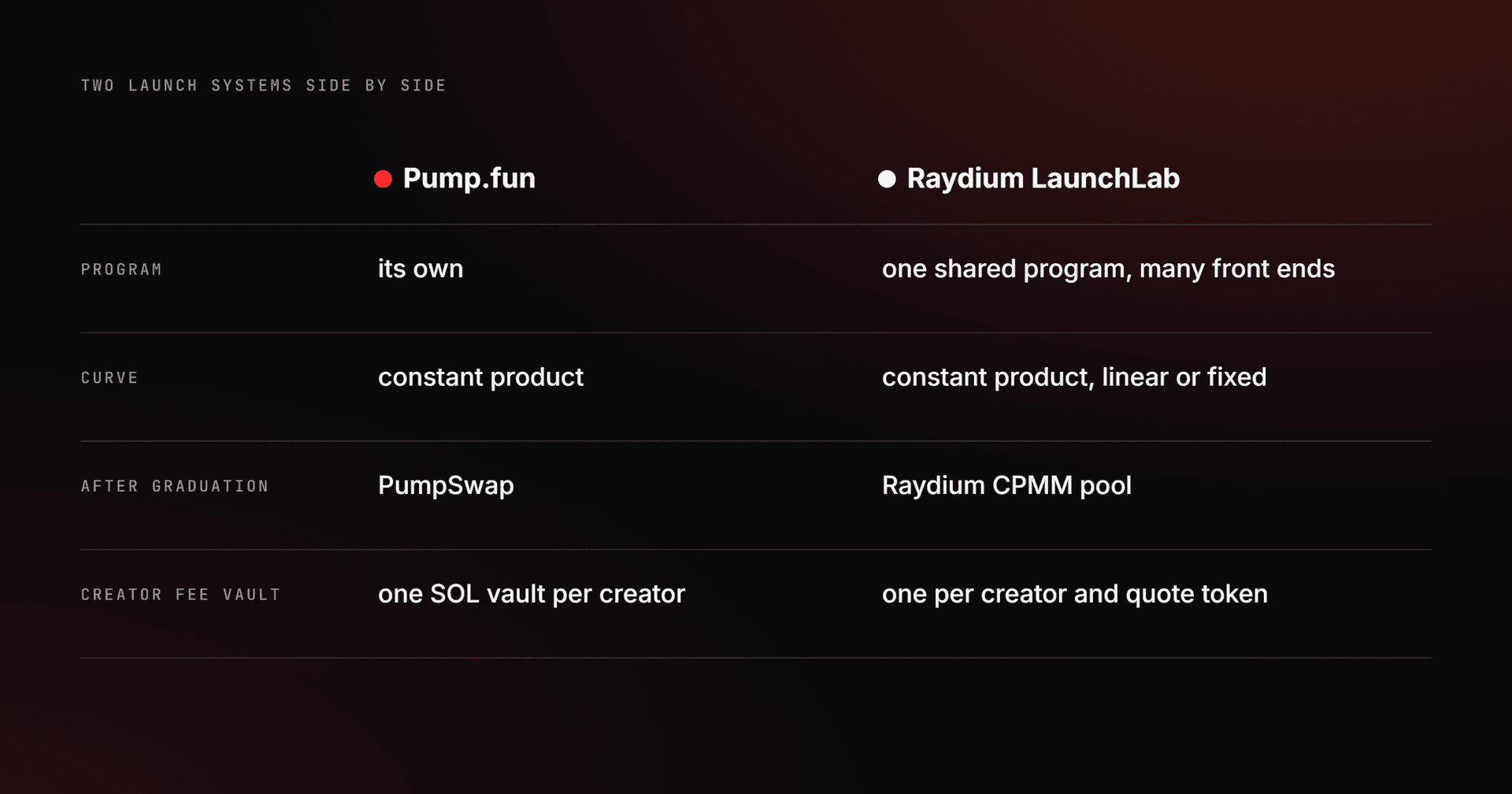
| Who runs the program | Pump.fun's own program | One Raydium program shared by many front ends |
| Curve shape | Constant product | Constant product in practice (linear and fixed price also exist) |
| Graduation target | About 85 SOL raised | Varies by launch: 85 SOL for 66% and 24 SOL for 29% of SOL-quoted launches |
| After graduation | PumpSwap pool, LP tokens burned | Raydium CPMM pool, LP tokens burned or locked by the platform's setting |
| Fee on the curve | 1.25% (0.30% creator, 0.95% protocol) | 0.25% to Raydium plus the platform's fee, 1.05% to 1.50% in total on the three largest platforms |
| Creator fee vault | One SOL vault per creator | One vault per creator and quote token |
Both follow the same steps: a curve, then graduation into a regular pool. The difference is who sets the settings. Pump.fun's fee page lists one curve fee of 1.25%. LaunchLab hands the settings to each front end, so two coins on the same program can charge different fees and treat their liquidity differently.
How does a Raydium LaunchLab launch work?
- A creator picks a front end and fills in the coin. The full supply is minted at once.
- Part of the supply goes on a bonding curve and is bought and sold against a quote token. Among SOL-quoted launches, most (86%) put 79.31% of a 1 billion supply on the curve, and Raydium's creation guide allows between 51% and 80%. The full design is in Raydium's LaunchLab documentation.
- Every trade pays fees: Raydium's 0.25% protocol fee, the platform's own fee and, where the platform sets one, a creator share.
- When the quote token held by the curve reaches the target, the coin graduates. The program builds a Raydium CPMM pool from the quote token raised and the coins that were left.
- The pool's LP tokens are burned or locked, depending on the platform's setting.
A bonding curve prices the coin by how much of it has been sold. On a constant-product curve, early buyers pay less and later buyers pay more, with no order book and no one to match. The program supports three shapes: constant product, fixed price and linear price. In the 3,742 launches checked, every one used constant product, the form Raydium's docs describe for Pump-style launches.
Which platforms run on Raydium LaunchLab?
Raydium's public launch list returned 3,742 launches created in the 24 hours before 16:36 UTC on 3 October 2026. Their platforms split like this:
- StonkFun: 90.5% (3,385 launches)
- bonk.fun, listed on chain as letsbonk.fun: 2.8% (104)
- Raydium's own launchpad: 1.1% (41)
- Smaller platforms together: about 6%
Two more numbers matter to anyone trading these coins. Only 502 of the 3,742 (13%) were quoted in SOL. The rest used another token as the quote asset, for example NVDAx, USELESS or STONK, so buying them means holding that token first.
The second number is the transfer fee. Of the 3,742 launches, 3,412 (91%) were Token-2022 coins and 2,725 (73%) carried a transfer fee, mostly 1% or 3%. Almost all of those were StonkFun coins: all 3,385 of its launches were Token-2022, and 2,704 had a transfer fee. bonk.fun's 104 launches had neither.
A transfer fee is withheld from the coins every time they move between token accounts, and a buy or a sell is such a move. A 3% fee therefore costs you on each trade, on top of the curve's fees. What Is a Solana Tax Token? Token-2022 Transfer Fees covers where the withheld amount goes.
What fees does Raydium LaunchLab charge?
Raydium takes 0.25% of every trade on the curve. The platform adds its own fee, and may add a creator share, which the program caps at 0.5%. These are the settings measured for the three largest platforms on 3 October 2026:
| Platform | Platform fee | Creator share | Total on the curve | LP tokens at graduation |
|---|---|---|---|---|
| StonkFun (three main settings) | 1.00% | 0% | 1.25% | All locked, with the Fee Key held by the platform |
| bonk.fun | 1.25% (one setting 1.00%) | 0% (one setting 0.05%) | 1.50% (one setting 1.30%) | Almost all burned |
| Raydium's own launchpad | 0.75% | 0.05% | 1.05% | 90% burned, 10% locked |
Smaller platforms set their own fees, and some set them high: 167 of the 3,742 launches (4%) came from settings with a platform fee of 3% to 5%. Read the fee before you trade a coin from a platform you do not know.
For comparison, Pump.fun's fee page lists 1.25% on the curve and 0.015 SOL to graduate into PumpSwap. PumpSwap's own fee falls as market cap rises, from 1.25% at the lowest tier to 0.30% at the highest.
On the LaunchLab side, the platform also picks which Raydium CPMM fee config the graduated pool uses. Raydium lists 0.25% as the standard tier, but a platform can choose another, so read the pool's fee tier on Raydium before you trade it.
What happens when a LaunchLab coin graduates?
At graduation the curve stops, and the program creates the CPMM pool with the quote token raised and the coins that were left over. Since 17 August 2026, new launches must migrate to CPMM, so the old Raydium AMM v4 route is closed to them.
The LP tokens decide who can ever touch that liquidity. Burned ones are gone for good. Locked ones sit in a position where the liquidity can never be withdrawn, and whoever holds its Fee Key, an NFT, collects the pool's fees. Pump.fun burns its LP tokens at graduation. Burn, lock or hold: what happens to Solana LP tokens explains the three outcomes, and what happens after Pump.fun graduation covers the other route.
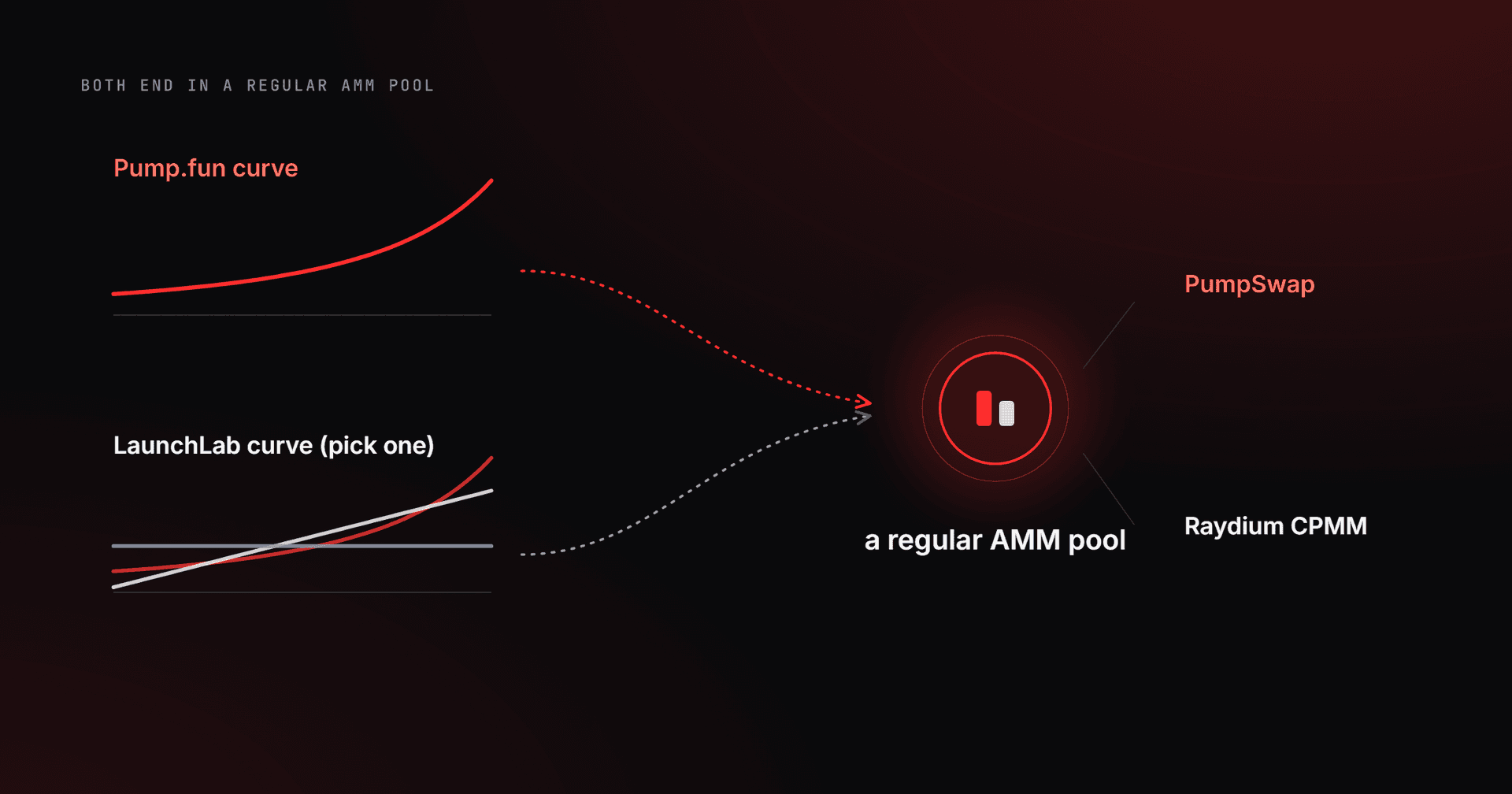
After graduation the coin trades like any other pool pair. PumpSwap is the Pump.fun side of that; What Is PumpSwap and how graduated coins trade walks through it.
Who earns the creator fees, and how do you claim them?
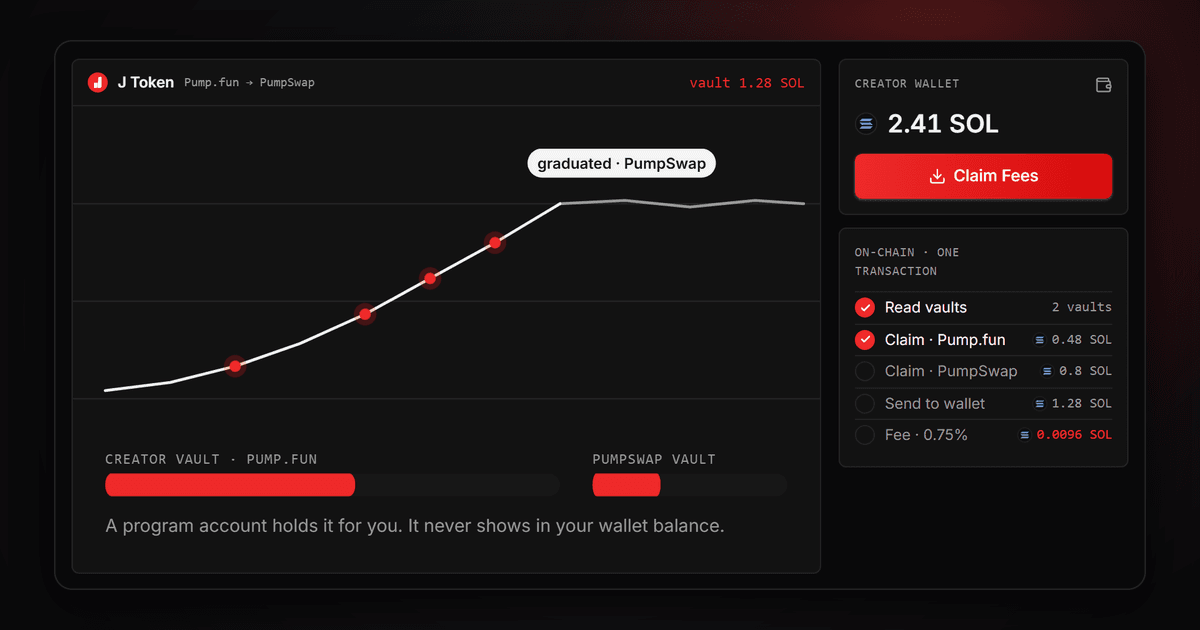
On LaunchLab, creator fees collect in a vault kept per creator and per quote token. The creator can claim them with the creator wallet's signature before or after graduation. Pump.fun keeps one SOL vault per creator instead, and Pump.fun Creator Vault: where your creator fees go shows how to find it.
Check the platform's setting before you expect income. StonkFun's three main settings pay creators 0%, so nothing builds up in a creator vault there. Where a platform does set a share, the money waits until the creator wallet claims it. If you launched from a wallet whose key you no longer hold, nobody else can claim it for you.
The free scan in Claim Center reads LaunchLab creator vaults along with the other fee sources, and Creator Fee Claim handles creator fees only. Claim Fees on Solana: Creator, LP, Tax and Rent in One Place shows where each kind of fee waits.
How do you check a Raydium LaunchLab coin before buying?
- Find the platform and the quote token. The curve takes that token, so you need it in your wallet to buy.
- Read the mint for a transfer fee. A 1% or 3% fee changes what you receive and what you can sell.
- Look at who holds the coin. J Map draws the top holders as clusters of linked wallets, free and without a wallet connection, and How to read token holder distribution shows what a healthy spread looks like.
- Check for a coordinated launch. How to check if a token is bundled lists the signs.
- Find out what the platform does with the LP tokens at graduation, using the fee table above.
Raydium LaunchLab: frequently asked questions
Is bonk.fun the same thing as Raydium LaunchLab?
No. bonk.fun is a front end built on LaunchLab, and on chain it appears as letsbonk.fun. The program and the curve are Raydium's. The front end sets its own fee and decides what happens to the LP tokens at graduation.
Is Raydium LaunchLab safer than Pump.fun?
Neither program makes a coin safe, and the program itself does not answer that question. What differs coin by coin on LaunchLab is who holds the coin, whether the launch was coordinated, any transfer fee and what the platform does with the LP tokens. Check those before you buy.
What is the graduation target on Raydium LaunchLab?
It varies by launch. Among SOL-quoted launches measured on 3 October 2026, 66% targeted 85 SOL and 29% targeted 24 SOL. Raydium's creation guide sets a minimum of 24 SOL for a SOL target.
Why can I not see my LaunchLab coin on DexScreener?
In a sample of 60 coins still on the curve on 3 October 2026, none appeared on DexScreener as a LaunchLab curve pair. Three of them had pools on Meteora, in the same sample.
Where do LaunchLab creator fees go?
They collect in a vault kept per creator and per quote token, and only the creator wallet can claim them. A platform can set the creator share to zero, as StonkFun's main settings do. Claim Center shows whatever is waiting for a public address.
Do LaunchLab coins use Token-2022 transfer fees?
Many do, mostly on StonkFun. Of the 3,742 launches checked, 73% carried a transfer fee, mostly 1% or 3%, and almost all of those were StonkFun coins. bonk.fun's launches had none. The fee is withheld whenever the coin moves, buys and sells included.
Where to go next
If you launched on a LaunchLab front end, run the free scan in Claim Center to see whether a creator vault holds anything. To go deeper on the other side of this comparison, the Pump.fun bonding curve guide explains how its curve prices a coin.